


Fiscal Lab Notes is the official Substack page for the Fiscal Lab on Capitol Hill. You can check out all our work and analyses at fiscallab.org.
Last week, we noted that our one-year anniversary as a charted organization is coming up on June 9. To celebrate, we discussed the need for the Fiscal Lab as well as the legislative analysis—one half of our mission—we’ve conducted over the past year. Such work includes scores of 83 legislative proposals under the Republican Study Committee’s (RSC) reconciliation 2.0 proposal. We have also scored and provided analytical support on dozens of other bills coming from both Democrats and Republicans.
Today, we’d like to discuss the other half of our mission—Hill education, as well as a productive meeting the Fiscal Lab team had with senior members of the Congressional Budget Office (CBO).
Educating Capitol Hill
To turn the United States’ fiscal ship around, Members of Congress and their staff will need to be much better educated about what good fiscal policy looks like and why bad fiscal policy leads to such pernicious effects. However, many staffers have little economics training, so interpreting economic analysis, whether from the CBO, the Joint Committee on Taxation (JCT), or for some other organization, can be difficult. This problem is compounded by high staff turnover, which makes it difficult for Congress to build collective institutional knowledge on fiscal policy matters.
To better educate Hill staff, the Fiscal Lab has created educational content both in the form of in-person trainings and video content.
In January and February, the Fiscal Lab conducted its inaugural “CBO 101” seminar series where we explained what CBO does, how to understand CBO’s work, and how to best work with CBO to House staffers. We also taught basic economic concepts including inflation and GDP and walked staffers through scoring exercises of different policy proposals.
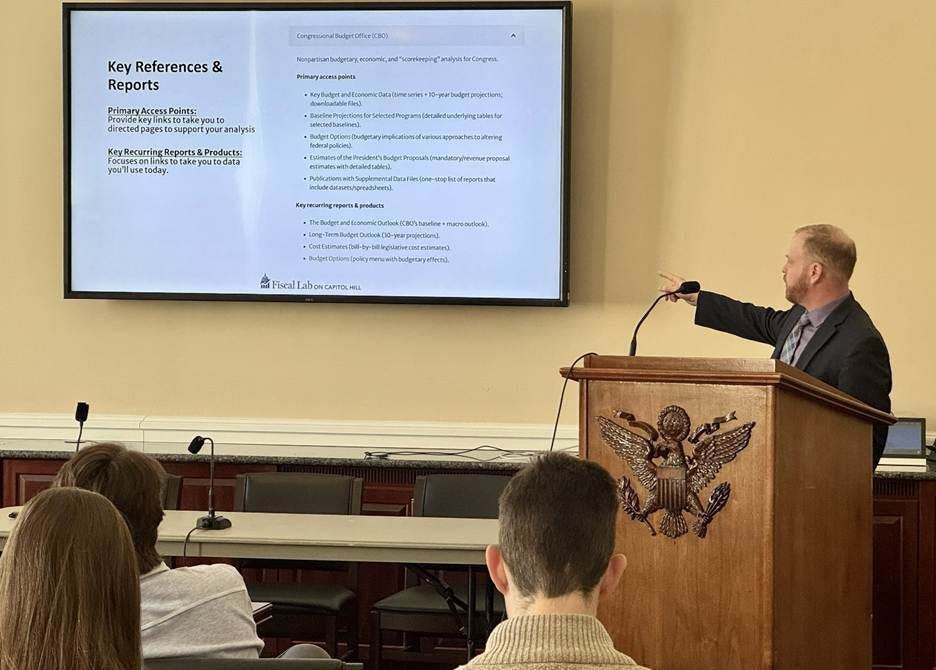
Fiscal Lab Senior Fellow Joe McCormack presenting to congressional staffers on “CBO 101”
As part of CBO 101, Bill Beach walked staffers through how to craft an effective scoring request letter to CBO. Following this, Michael Schultz wrote a primer titled “How to Write a Scoring Request Letter to CBO,” based on Beach’s presentation for anyone to use (more on this in a moment).
We have also given presentations to Senate staffers on interpreting the CBO’s baseline and have had many private briefings to staffers from both Houses on issues their Members are especially interested in.
Video Strategy
In addition to being physically present on the Hill, the Lab has also created a YouTube channel where we post recordings of our public Hill presentations as well as conversational videos on important fiscal topics. For example, Beach and I recorded an episode on the economic and budgetary implications of the closing of the Strait of Hormuz due to the war with Iran. Parker Sheppard and Beach also recorded an episode on a 3 percent deficit-to-GDP target, an increasingly discussed practical proposal to get the United States’ debt under control.
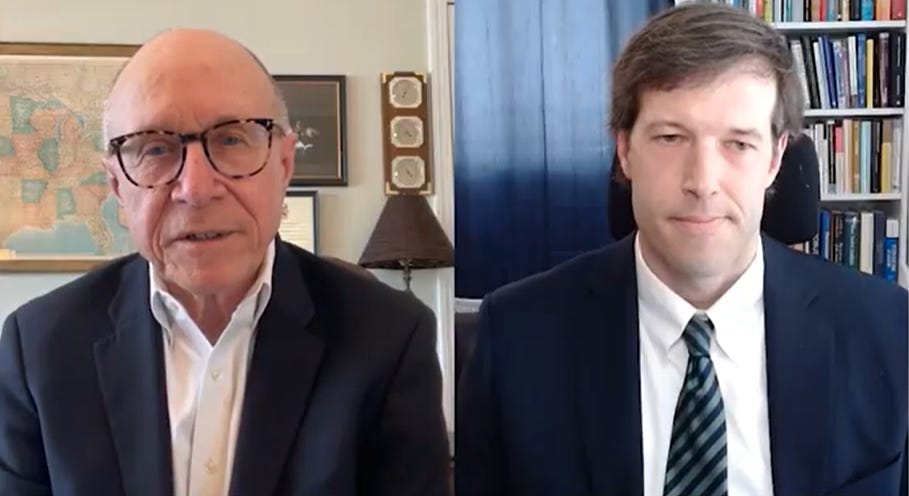
Bill Beach and Parker Sheppard discuss the appeal of a 3 percent deficit.
As we move into our second year, we plan to produce similar videos as well as more structured course-like content on fiscal and economic matters.
Meeting with the CBO
This week, the Fiscal Lab team met with senior CBO staff, including Director Phillip Swagel to discuss the aforementioned scoring request letter primer. CBO leadership expressed interest in how we can expound upon this guide and offer similar educational material. The conversation reinforced that our educational material improves clarity and facilitates better analysis for congressional offices.
The meeting also highlighted several opportunities for future educational resources for Congress and congressional staff. We discussed how to help policymakers better understand what goes into a CBO score, the importance of distinguishing between the roles of CBO and JCT, and why legislative language must be drafted with sufficient specificity to be scoreable. We also explored ways that outside research can support the scoring process, particularly in areas such as fraud prevention. As a result of these discussions, Fiscal Lab plans to expand its guidance by developing a broader set of resources that help offices understand how CBO evaluates legislation, what information is most useful to analysts, and how policymakers can formulate questions that lead to more meaningful budgetary analysis.