


Fiscal Lab Notes is the official Substack page for the Fiscal Lab on Capitol Hill. You can check out all our work and analyses at fiscallab.org.
The Fiscal Lab received its charter as a nonprofit corporation on June 9, 2025. With our one-year anniversary approaching, the Fiscal Lab will use this Weekly Lab Report and the next two weeks’ Reports to assess the work it’s done so far — both in scoring legislation and educating Members of Congress and their staff — as well as the challenges that lie ahead.
The Need for the Fiscal Lab
The United States finds itself in a worsening fiscal crisis. Credit downgrades, rising bond yields, rising deficits, and ballooning debt threaten the US’s ability to meet its obligations and to carry out its major functions including national security, public infrastructure, and a social safety net.
Although Members of Congress have ideas for turning America’s fiscal ship around, the Congressional Budget Office (CBO) and Joint Committee on Taxation (JCT) focus heavily on providing analytical support to congressional leadership and some senior Members, leaving senior and nearly all junior Members with less support. This neglect has consequences: It’s practically impossible to bring a vote to the floor without a CBO or JCT score, which leaves Members who cannot get CBO or JCT support in a bind.
The Fiscal Lab exists to educate Members and their staff—both Republicans and Democrats—and to help score their draft legislation, especially if they are having trouble getting support from CBO or JCT. This week, Executive Director Bill Beach went on the Macro Musings podcast where he observed, “The lab, in short, is there to educate Members and their staff about economics and the budget, and then to score their bills so that no good idea dies from lack of analysis.”
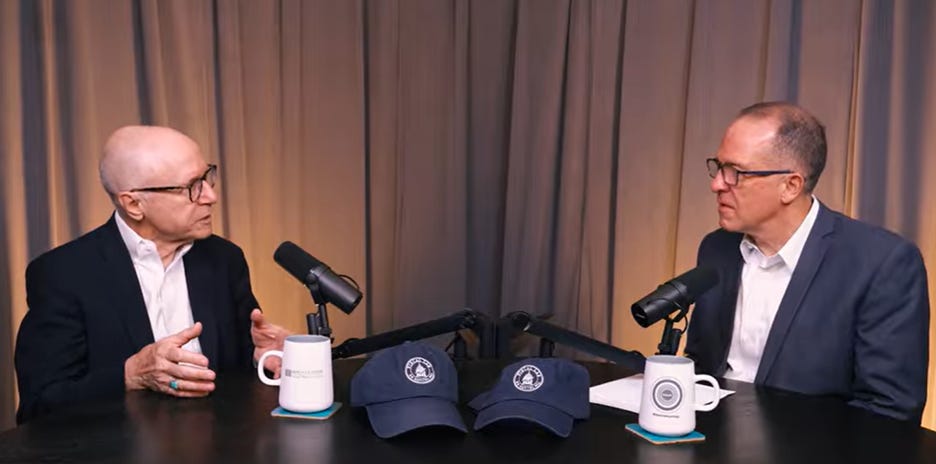
Bill Beach and David Beckworth on the Macro Musings podcast
To understand the context into which the Fiscal Lab was born, we need to take a slightly deeper dive.
The Constitution empowers Congress with making the fiscal choices for all federal operations. So why does it feel like the Congress has no control—or is just rubber-stamping administration spending—and is there any hope for a more robust Congress in the future?
Some of this apparent lack of control stems from the growth of congressional factions. Congress and even the parties within Congress are often divided. Control can be split between House and Senate with interparty disputes. Then, the parties themselves within Congress can be divided by intraparty disputes. This weakens Congress and makes prudent fiscal decisions incredibly difficult to reach.
Another reason is the rise of the administrative state. Since the beginning of the progressive era (which we date to the late 1800s with John Dewey, Richard Ely, and Woodrow Wilson), the executive branch and administrative state rapidly expanded with “experts” drawn into the growing alphabet soup of federal agencies. Today, the administration brain-trust of technical professionals often write the laws, which they later administer, that administrations push Congress to enact. Congress simply does not have the professional firepower to compete, leading Congress to defer and become dependent on the administration.
Attempts to bring balance—like the legislative reorganization of the late 1940s, and the 1974 Budget and Impoundment Control Act—have done little to shift the imbalance. As of March 2026, over 2 million civilian, nonmilitary, nonpostal service workers are employed by the administration, while only 31,000 work for the legislative branch. Even where Congress has talented and specialized staff—especially on committees—there are too few staff to truly manage and perform needed oversight of the current federal fiscal environment.
Making matters worse for Congress, the number of staff working on policy is far less than even the 31,000 number. Committee and leadership staff number around 6,000 and personal staff around 12,000. Then 5,000 of the 12,000 are state and district staff, meaning that at most 13,000 staff are working on developing policy and performing oversight for Congress. (And the number is far lower if communications and administrative staff are not counted.)

The staff of the Fiscal Lab on Capitol Hill.
The Congressional Budget Office and the Joint Committee on Taxation are the official legislative cost estimate entities for Congress, but they get backlogged and prioritize leadership and committee bills, which leaves rank-and-file Members, especially those in the minority, with effectively no analytical support.
The Fiscal Lab is not the first effort to build better policy through better analysis. In 1997, Beach launched the Center for Data Analysis (CDA) at The Heritage Foundation to provide such support, but CDA’s analytical work for Congress has receded over the past decade. The void is palpable and the current generation of staff and Members are increasingly left in the dark.
Meanwhile, we have experienced explosive growth in federal spending and debt from policies like those in the wake of the 2008 Great Financial Crisis, COVID spending, the Inflation Reduction Act, and the imminent insolvency of Social Security. The need for widely available, independent, and credible analytical support is keenly felt and needed more than ever.
One Year In
In this environment, the Fiscal Lab on Capitol Hill was born in June 2025, achieved its tax-exempt status in July, and formally launched amidst the government shutdown in the fall of 2025. Fiscal Lab quickly attracted an amazing team of seasoned congressional veterans and economic PhDs, gained support from benefactors interested in advancing sounder public policy by providing House and Senate Members with better analytical support; and now enjoys the respect of Democrats and Republicans alike, as well as the CBO, congressional committees, and rank-and-file Hill staff from both parties. We’re not a think tank; we are a “do” tank.
Since September 15, 2025 (our official launch date), we have been privileged to study proposals and offer one-on-one insights to senior and junior Republicans and Democrats. Among our first tasks was evaluating and providing 10-year conventional cost estimates for 83 separate legislative proposals under consideration for the Republican Study Committee (RSC) reconciliation 2.0 proposal, including full documentation of sources, assumptions, and modeling. House leadership chose our work in providing insights on those proposals for the final reconciliation bill, but just as important was our work on providing insights for policies that were not included. We helped the Representatives better understand the policies before them so that they could make better choices for their proposal and their constituents.
From both the House and Senate, Democrat and Republican Members and staff are asking the Fiscal Lab to study a wide range of legislative proposals that ultimately are introduced and find their way to the floors of the two chambers. The Lab doesn’t write the bill, but we provide many suggestions for improving the bill’s effectiveness, should it become law. In the end, the Lab supplies documented analytical support so that offices can make better-informed decisions. Increasingly, we are also providing staff training, staff workshops, and briefings for both House and Senate Committees. For example, Beach testified recently at a House Oversight Committee Roundtable, and on multiple occasions senior Members have invited us to meetings to discuss the fiscal effects of policies under consideration.
The close working relationships that we are developing with many Member offices is broadening our work from scoring bills to assisting Members in thinking through the formulation of letters to the official scoring bodies. CBO has taken notice of our guide for writing to the official scoring organization, and our work is greatly appreciated by our core audience.
The Fiscal Lab’s work with Congress is just beginning. The congressional appetite for independent, rigorous, transparent budget and regulatory analysis is strong. Fiscal Lab’s future looks bright.