

Fiscal Lab Notes is the official Substack page for the Fiscal Lab on Capitol Hill. You can check out all our work and analyses at fiscallab.org.
Teaching the Basics of CBO and Scoring
Last week, the Fiscal Lab held its first educational seminar on Capitol Hill! The seminar, which was attended by about 20 bright congressional staffers, was the first in a three-part series titled “CBO 101: Understanding the Baseline Budget & Economic Outlook, Scoring, and Transparency.”
The purpose of this series is to educate staffers on how the CBO (the Congressional Budget Office) works, how congressional staffers can get the most out of making requests of CBO, and how to interpret CBO’s models and scores. Staffers attending this series will have a better sense of what CBO considers and doesn’t consider when it scores legislation, and will be in a better position to assess CBO’s judgments.
Doug Branch opened up with a brief introduction of the Fiscal Lab and then a historical overview of the US budget process from the American Founding to today. Next, Executive Director Bill Beach explained the structure of the CBO and walked through the exact steps in making a request to CBO.
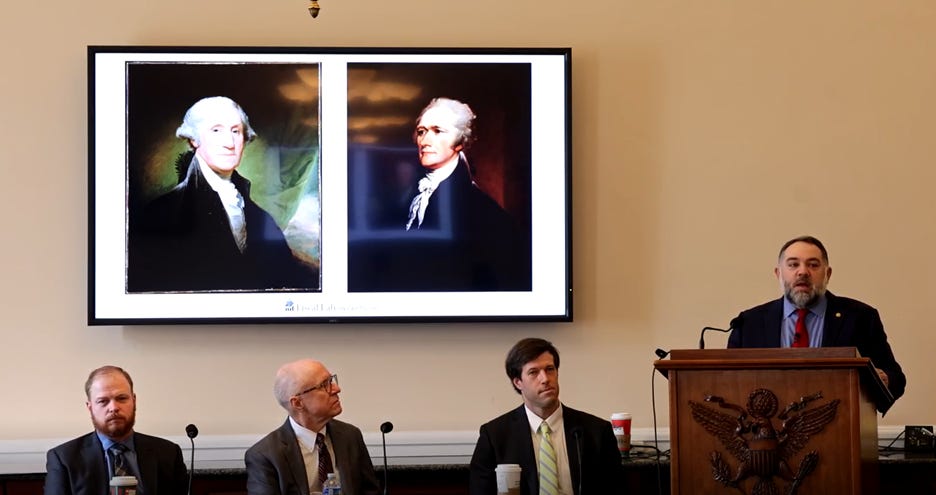
Fiscal Lab Staff (left to right): Joseph McCormack, Bill Beach, Parker Sheppard, Doug Branch
Parker Sheppard then taught attendees about CBO’s budget, economic, and demographic projections. He wrapped up the day by giving a hands-on Excel workshop where staffers evaluated a policy proposal, using these projections. (The example used in the workshop is discussed in our very first newsletter.)
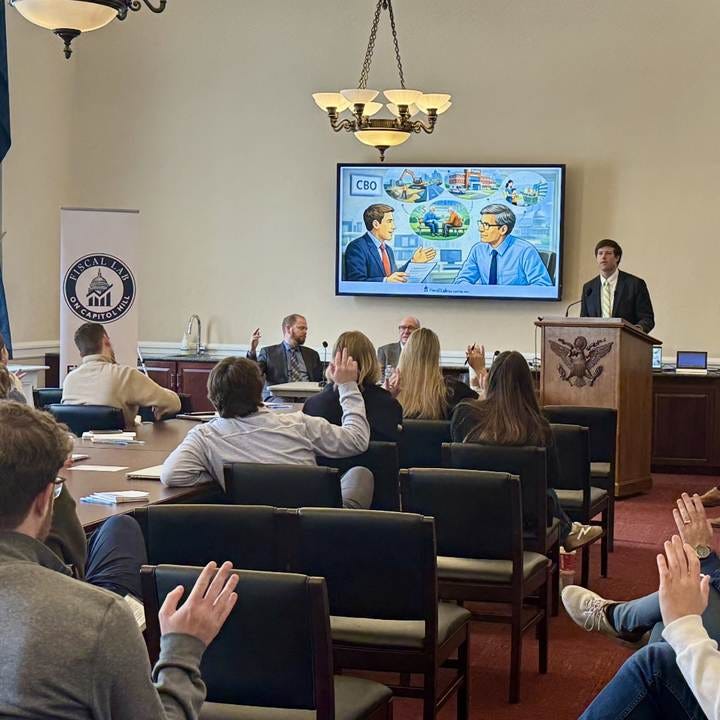
Parker Sheppard and staffers discuss CBO and scoring.
Part 2 of this series, which will focus on basic economic concepts and other helpful data sources for scoring, will be held next week. Also, be on the lookout for video links of all our seminars in the coming days.
Inflation and Affordability
The Fiscal Lab’s Patrick Horan spoke with EWTN, America’s premier Catholic broadcasting network, on the state of the US economy, the latest inflation numbers, and affordability concerns.
Horan noted that the Consumer Price Index rose 2.7 percent in December from one year earlier. While that’s lower than where inflation was in the summer and early fall of 2025, inflation is still too high relative to the Fed’s 2 percent inflation target. He also observed that recent jobs data and GDP data are providing different signals as jobs data has generally been weak, while GDP data has been relatively strong.
Finally, Horan responded to President Trump’s desire to ban large institutional investors from buying single-family homes and for credit card companies to cap interest rates. Although these policies may sound good for affordability, Horan cautioned they may do more harm than good. Institutional investors are not a big part of the housing market, so banning them would do little to the overall market. A much better way to achieve housing affordability would be to liberalize zoning and other rules, which make it difficult to build housing and constrain supply. Capping credit card interest rates would choke off access to credit for those least well off. If the president wants to reduce interest rates, he should work with Congress to reduce budget deficits, which put upward pressure on rates.
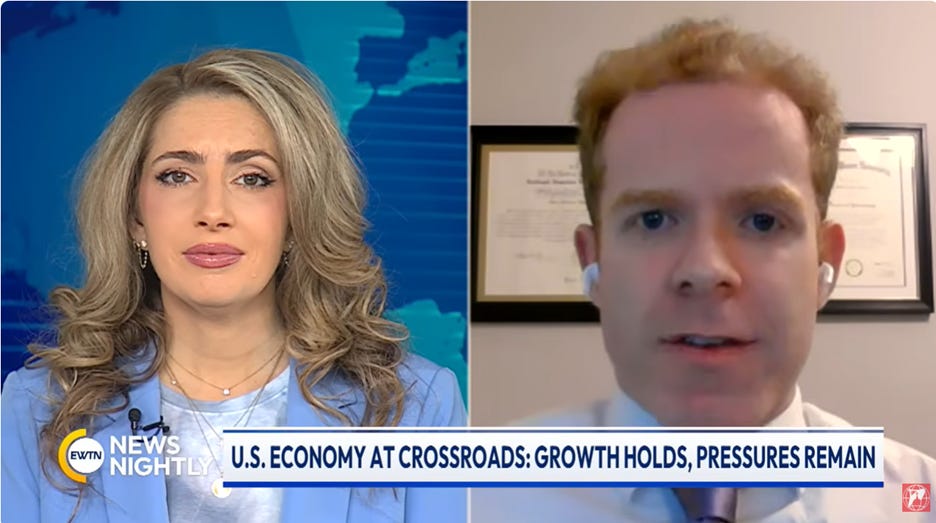
Patrick Horan on EWTN News Nightly.