

Some Good Jobs Numbers
Earlier in September, the Fiscal Lab’s Bill Beach analyzed the Bureau of Labor Statistics’s (BLS) August 2026 Employment Situation, which showed nonfarm payroll employment rising by 162,000 in August and upward revisions to job growth for both June (20,000 to 31,000) and, particularly notably, July (−23,000 to 21,000), with the unemployment rate holding at 4.1 percent.
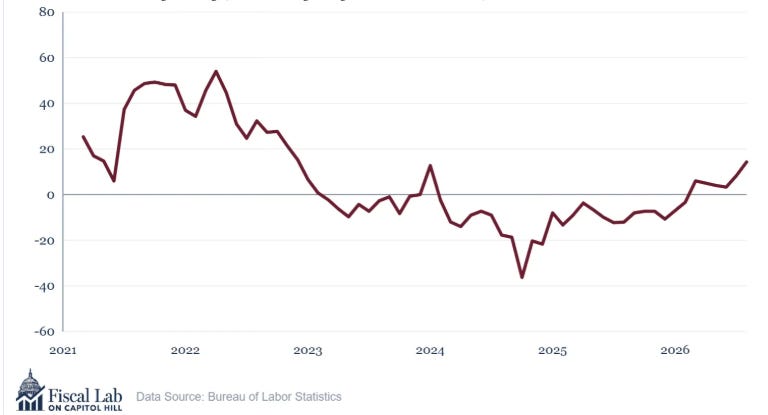
We can also see rosy numbers when we look beyond the topline statistics. Manufacturing employment, which has seen a long downward trend over the past four decades, has increased by 56,000 this year. We see the three-month moving average of manufacturing employment in Figure 1. Beach also pointed to modest improvements in labor force participation.
Figure 1. Monthly Change in Total Non-Farm Payroll Employment (In Thousands)
Not all numbers in the report were good. The number of unemployed individuals rose to 7,031,000. These are people who are looking for work but remain jobless—and they deserve the attention of policymakers.
Of course, we’ll see what data revisions bring, but the latest report is a testament to the resilience of the US economy in the face of war, inflation, and financial market stress.
Hot Prices
While the BLS’s August jobs numbers look good, its Consumer Price Index (CPI) inflation numbers for the same month do not. The overall headline CPI rose 0.4 percent from the previous month and 3.4 percent over the past 12 months.
Much of the CPI’s rise owes to a jump in the gasoline index, which rose 3.9 percent over the month. However, the monthly core CPI, which strips out food and energy prices, also rose at a hot 0.3 percent, a tenth of a point above expectations (a 0.3 percent monthly rate is roughly consistent with an annual 3.5 percent rate).
Persistently high inflation is a major challenge for the Federal Reserve, whose primary job is price stability, but it is also a challenge for Congress. In a new Fiscal Lab video, Senior Fellow Parker Sheppard explained how both monetary and fiscal policy affect the price level.
Congress has given the Fed the power to print money, but if Congress continues to run large deficits, fiscal dominance could take hold—forcing the Fed to monetize that debt. Sheppard provided two starting points for how Congress can help reduce inflation. First, it could commit to a credible deficit target—such as 3 percent of GDP—to anchor expectations about Congress’s ability to pay off its debt. Second, the Congressional Budget Office (CBO) could count interest costs when it scores legislation, giving Congress a fuller understanding of a bill’s true costs.
The Deficit and Debt Are Family Affordability Issues
Recently, media outlets reported on a draft White House proposal to let low- and moderate-income families with a stay-at-home parent receive federal childcare subsidies. The proposal would modify the rules governing the Child Care and Development Fund (CCDF), which is designed to encourage parents to work by subsidizing their preferred childcare provider, whether a daycare center, the local church’s preschool, or a family member such as a grandmother. The proposal would let families use the subsidy even if a parent stays home.
Proponents argue that this change would make childcare policy more neutral by putting stay-at-home parents on a more equal footing with those who work. Critics counter that the choice to be a stay-at-home parent rather than participate in the workforce should not be subsidized by the federal government.
Although the proposal is about the flexibility of an existing program, the impetus behind it has much to do with affordability, which has been a top financial concern for many Americans. Whether it’s inflation, energy costs, housing, or healthcare, many citizens are anxious about their ability to make ends meet.
The Fiscal Lab does not weigh in on the merits or demerits of proposed program modifications like this change as that is for policymakers to decide, but we aim to be helpful to all parties in shedding light on the probable fiscal effects of policy changes. Given how central affordability is right now, it’s worth reiterating fiscal policy’s broader role in it.
Chronic, massive deficits and mounting concern over the US’s ability to service its debt have put sustained upward pressure on Treasury yields—pressure that spills over into the rates consumers pay on mortgages, auto loans, and credit cards. As the Fiscal Lab’s Joseph McCormack recently argued in a speech to the National Economists Club, the US’s worsening debt burden can only be resolved through some combination of lower future spending, higher revenue, higher inflation, or higher economic growth. While greater economic growth would be welcome, it would have to sustainably grow well above four percent—an extremely difficult feat—to balance the budget.
If Congress is to take affordability seriously, it will need to move in the direction of fiscal prudence.