


Fiscal Lab Notes is the official Substack page for the Fiscal Lab on Capitol Hill. You can check out all our work and analyses at fiscallab.org.
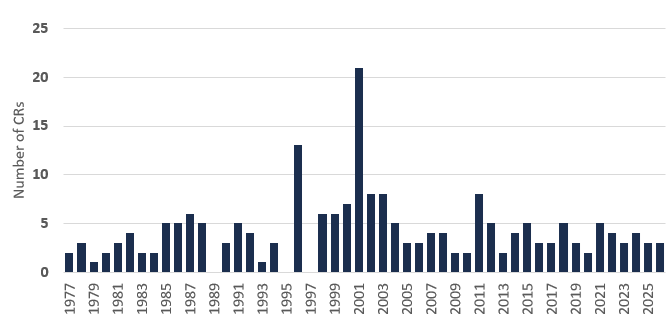
Congress is considering a continuing resolution (CR) that would prevent a government shutdown when appropriations lapse at the end of the fiscal year (FY) on September 30, 2026. If enacted, this would be the 211th CR in the last 50 years.
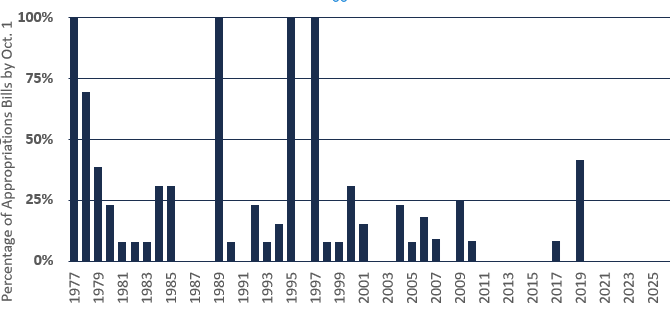
Continuing resolutions are required because Congress is almost never able to complete the regular appropriations process on time. In the last 50 years, Congress has enacted all regular appropriations bills by the start of the fiscal year only four times. This feat was last accomplished 29 years ago in FY 1997 (as shown in Figures 1 and 2).
Figure 1. Continuing resolutions are common
Sources: Authors’ calculations based on Appropriations Acts and Congressional Research Service
Figure 2. Congress rarely follows regular order for appropriations
Sources: Authors’ calculations based on Appropriations Acts and Congressional Research Service.
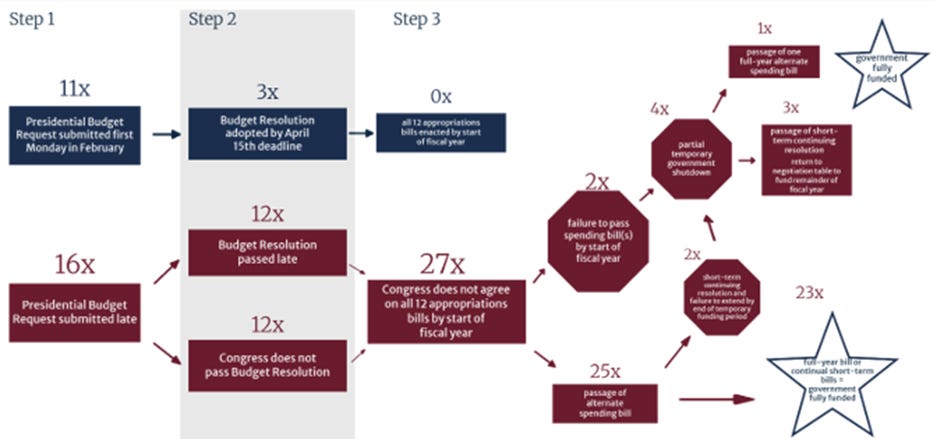
The budget process is undeniably broken. Figure 3 shows the “regular order” of the budget process in blue and how many times those steps were successfully followed in the past 27 years. It shows the number of deviations from the process in red. Nearly every major step now routinely fails to be accomplished on time, if at all. Since fiscal year 2000:
· The president’s budget request was late 16 times.
· Congress has failed to adopt a budget resolution 12 times. Of the 15 resolutions it did adopt, 14 included reconciliation instructions. Only three budget resolutions were adopted by the April 15 deadline.
· Congress never completed all regular appropriations bills by the start of the fiscal year.
· There have been six government shutdowns, caused by failures to pass appropriations bills or a CR.
Figure 3. How many times the government followed “regular order” vs. deviated from law (2000–2026)
Sources: Congressional Research Service, US Government Publishing Office, and Congress.gov (updated through FY2026)
The process designed by the Congressional Budget Act of 1974 is aimed at promoting enactment of the annual appropriations bills. Moreover, it was crafted for different budgetary, economic, and political conditions than lawmakers face today. The current budget process is not focused on promoting sustainable fiscal outcomes or even ensuring that Congress spends its time on the most important policy issues. The consequences are clear: The drivers of rising deficits are left to grow on autopilot, leading to escalating budgetary stress.
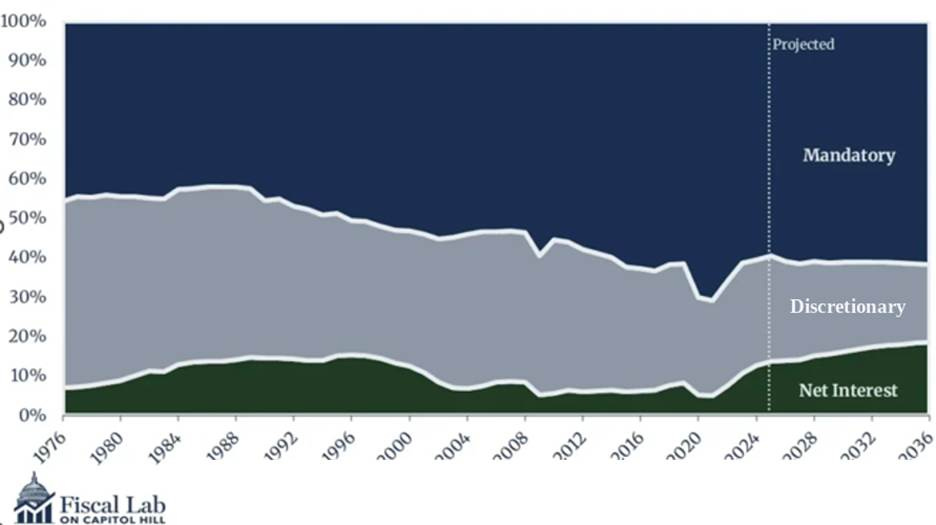
1974 was the last year that discretionary spending made up the majority of annual spending. As shown in Figure 4, discretionary spending is now only 25 percent of the budget, while autopilot mandatory spending and net interest costs consume 75 percent of annual outlays.
Figure 4. Federal outlays by category, 1976–2036
Sources: Congressional Budget Office, The Budget and Economic Outlook: 2026 to 2036, Authors’ Calculations
Many lawmakers lament the breakdown of the “regular order” budget process and view the need to pass CRs as part of the problem. However, the prevalence of continuing resolutions is just a symptom of the larger problem.
The imagined “good old days,” when Congress routinely completed its budgetary work on time, were never the norm.
Even if Congress did diligently work to complete the annual appropriations process on time each year, that could misallocate lawmakers’ valuable time and attention because discretionary spending is a small and shrinking slice of the budget.
Congress should not necessarily measure the success of the budget process by whether lawmakers complete 12 appropriations bills on time. A modernized budget process would require Congress to confront the causes underlying the federal government’s unsustainable fiscal trajectory.
Continuing resolutions are a symptom of a broken process. The solution is not simply to restore the process of the past, but to modernize it for the fiscal challenges Congress faces today.
Presenting for the National Economists Club
Earlier this week, Joseph McCormack presented to the National Economists Club on the federal budget outlook. His lecture, “The Cost of Delay,” stressed that the federal debt will require deleveraging, which will put households under pressure. Moreover, the longer the federal government waits, the more painful this pressure will become.
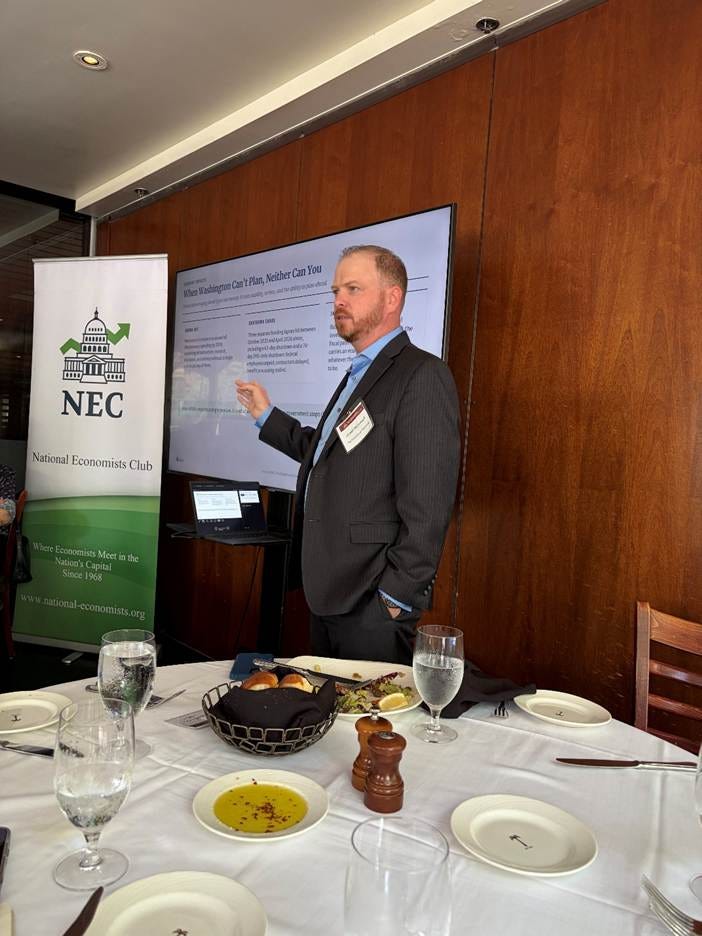
The Fiscal Lab’s Joseph McCormack
McCormack discussed the broken budget process outlined above where Congress regularly fails to fund discretionary spending, an increasingly small part of the budget, on time, while mandatory spending and interest expenses grow as a fraction of federal spending. He also discussed the history of reforms Congress has tried before like the 1985 Gramm-Rudman-Hollings Act and the 1990 Budget Enforcement Act, which instituted deficit targets and discretionary spending caps, respectively. However, in both cases, Congress found ways to sidestep the rules put in place by these laws. For example, Congress can declare certain spending as “emergency” that does not need to be offset elsewhere. While certain proposals like a 3 percent deficit-to-GDP target are promising, McCormack argued that such rules need to be implemented in a way that Congress does not undermine them later.
McCormack pointed to current examples of the grim outlook having visible effects. For example, credit downgrades and a rising term premium have contributed to higher interest rates for auto loans and mortgages, driving up to higher costs of living for families. He also pointed to the different levers the government can pull to reduce the debt burden: 1) achieve future primary surpluses through fiscal reform (either reduce spending and/or raise revenue); 2) boost economic growth; 3) create surprise inflation to reduce the real value of debt; 4) hold government debt below market yields (what economists call “financial repression”); and 5) default.
Boosting economic growth would be beneficial, but it is highly unlikely that pro-growth reforms can alter the US’s fiscal trajectory on its own. Surprise inflation can work in the short run, but this is painful, and once markets come to expect higher inflation as a strategy, it will fail. Financial repression similarly punishes savers and could cause capital to leave the US, which would undermine investment, and default would be catastrophic because it would substantially weaken the dollar’s standing as the world’s reserve currency.
Fiscal reform is the only route that Congress fully controls. Moreover, it is essential to getting the US’s debt trajectory under control. The sooner Congress understands this and acts on this, the better.
Fully agree that CRs are a symptom of the larger problem of a budget process that no longer works. The joker in me wants to re-label the term as "Continuing Irresolution" to more accurately describe the inability to make a decision. And "CI" must always be pronounced "sigh."