


Fiscal Lab Notes is the official Substack page for the Fiscal Lab on Capitol Hill. You can check out all our work and analyses at fiscallab.org.
Appropriations Basics
With Congress’s fiscal year ending on September 30, the Fiscal Lab recently hosted a seminar, “How to Read Appropriations Bills,” led by Matthew Dickerson for House staffers. The Fiscal Lab spends a large portion of its time on educating mid- and senior-level staff. High turnover in these positions fuels a steady demand for critical skills development, and the Lab’s training work helps build a staffer’s ability to support the House or Senate Member’s constitutional duties.
Appropriations provide agencies funding for particular purposes over specific periods of time (typically, but not always, one fiscal year or “full year”). Congress is supposed to fund the discretionary component of the federal budget—items including defense, disaster, education, and infrastructure—through 12 regular appropriations for the upcoming fiscal year (October through September). Dickerson went over what goes into the regular appropriations bills as well as related concepts including supplemental appropriations, which provide additional budget resources; continuing resolutions, which extend current funding when regular bills are not passed; omnibus bills, which are various packages of some or all 12 regular bills. He also discussed features of appropriations bills including riders and provisos, rescissions, and earmarks.
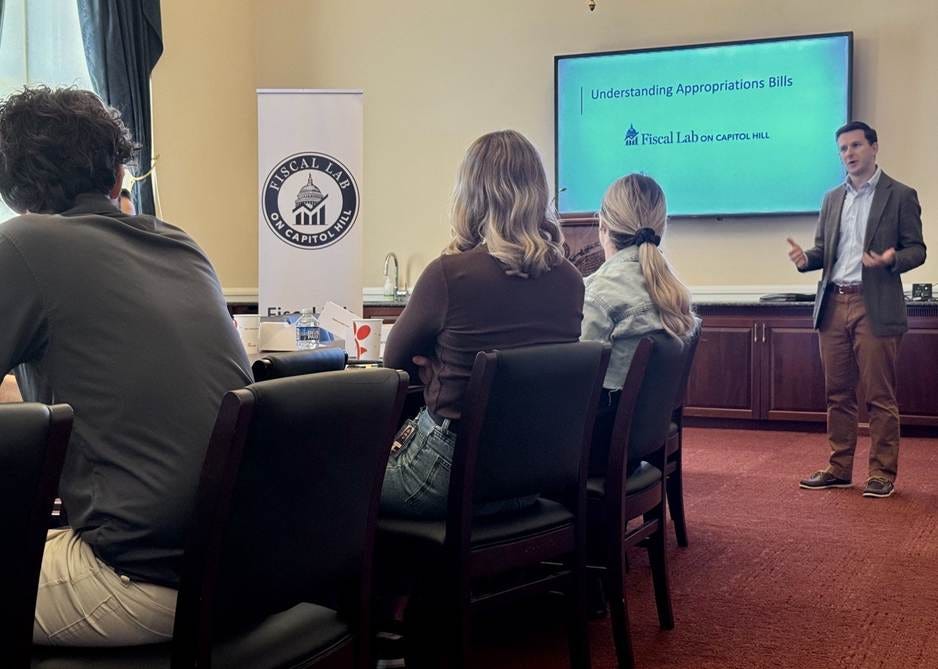
Fiscal Lab Senior Fellow Matthew Dickerson speaking to staffers on the federal appropriations process.
Importantly, Dickerson walked through how to interpret an appropriations bill. Staffers need three documents. First, they need the actual bill text, but it is often short and not detailed, despite authorizing billions of dollars in spending. Second, they need the corresponding House or Senate Appropriations Committee Report, an explanatory statement for how spending should be carried out. Third, they need the Report’s tables, which show detailed funding levels, the difference between actual spending and the president’s requested amounts, and the increases and decreases in spending compared to last year.
The Fiscal Lab has also created a video playlist going over many of the same topics Dickerson addressed.
Beach at NABE
On Tuesday, July 28, Bill Beach joined several distinguished speakers at the National Association for Business Economics (NABE) Foundation’s 23rd Annual Economic Measurement Seminar in Washington, DC. The seminar brought together expert data producers and data users for a practical discussion of the statistics, forecasts, and methods economists rely on to understand the economy. The program examined more than 100 data series, how they are applied, and how they provide a comprehensive understanding of the most important measures of economic activity, supporting better discussions around business decisions, policy debates, market analysis, and forecasting.
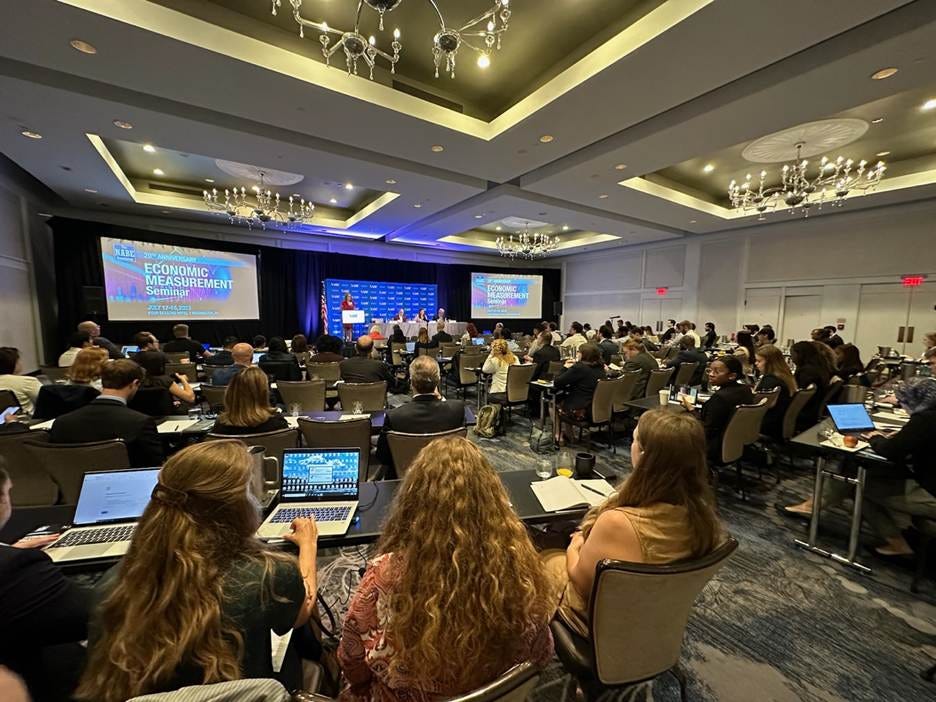
The NABE Economic Measurement Seminar
Beach addressed a large audience as part of the “Forecasting and Financing Fiscal Deficits” panel, moderated by Dana Saporta, retired economist and former NABE board member, alongside Joshua Stachura of the US Treasury Office of Debt Management. The panel focused on the underlying data and concerns surrounding the United States’ deficit and debt problem. Beach delivered an engaging and, at times, humorous presentation that focused on the very serious fiscal issues facing the country: rising deficits and debt, increasing interest expense, and the expansion of mandatory spending programs that are crowding out discretionary spending and private investment, and contributing to inflationary pressure.
Beach emphasized the need for a return to the “Hamiltonian norm,” the principle that Congress should not act over the long run in a way that endangers the public debt or weakens confidence in its convertibility into other assets. Unfortunately, the United States has moved away from this norm in recent decades. As Beach noted, deficits are no longer being driven primarily by discretionary spending, but increasingly by mandatory spending and interest expenses. He stressed that interest expenses now exceed all defense discretionary spending and will soon exceed nondefense discretionary spending. Moreover, while the Congressional Budget Office (CBO) baseline already shows a troubling rise in debt levels, even that outlook may be too rosy.
Despite these challenges, Beach argued that the country is not destined to follow the current debt forecast. Avoiding that path, however, will require credible analysis, discipline, bipartisan solutions, and the political will to act in ways that lead to better fiscal choices today.