


Fiscal Lab Notes is the official Substack page for the Fiscal Lab on Capitol Hill. You can check out all our work and analyses at fiscallab.org.
The Hamiltonian Norm
In a new Fiscal Lab Update, Bill Beach argues that for Congress to turn America’s fiscal ship around, it needs to revive the Hamiltonian norm, the commitment to always defend the integrity of US debt. This norm stipulates a return to fiscal discipline after periods of deficit spending or excessive revenue reductions. The name comes from the United States’ first Treasury Secretary, Alexander Hamilton, who convinced European money markets in the 1790s to lend to the United States to pay off enormous debts incurred during the American Revolution and very early years of the republic.
Importantly, the norm does not mean that the incurring of debt is inherently problematic or that the debt needs to be paid off in full. Hamilton believed in refinancing existing debt to stay current on fiscal obligations, and that “a national debt, if it is not excessive, will be to us a national blessing” because a moderate debt would establish American credit worthiness.
We can see Congress’s commitment to the Hamiltonian norm for much of US history in the figures below, as well as its abandonment of the norm in recent decades. Figure 1 shows budget deficits (in red) or surpluses (in green) as a percentage of gross domestic product (GDP) from 1790 to 2025. Through World War II, we see a pattern where large deficits are incurred during wartime, but most other years see surpluses or very small deficits. We then see some surpluses in the postwar years as well as 1998–2001, but we otherwise see annual deficit after deficit, especially large since the Great Recession.
Figure 1. The federal budget as a percent of GDP
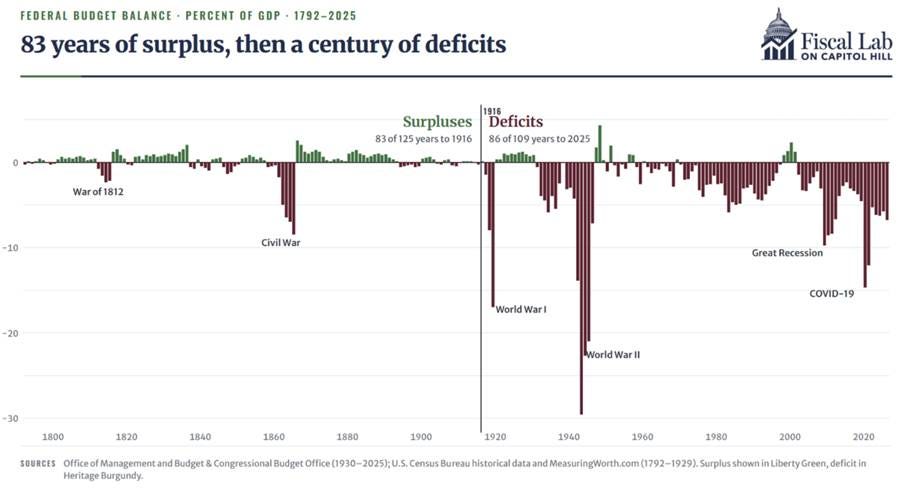
Figure 2 shows the ratio of publicly held debt to GDP over the same period. We see similar patterns. First, debt to GDP trends downward as the United States paid off its Revolutionary War debts. We then see spikes related to wartime spending followed by falls. However, beginning in 1974, we see debt-to-GDP rise again and become especially pronounced in the present day (with a brief respite in the 1990s and early 2000s).
Figure 2. Publicly held debt as a percent of GDP
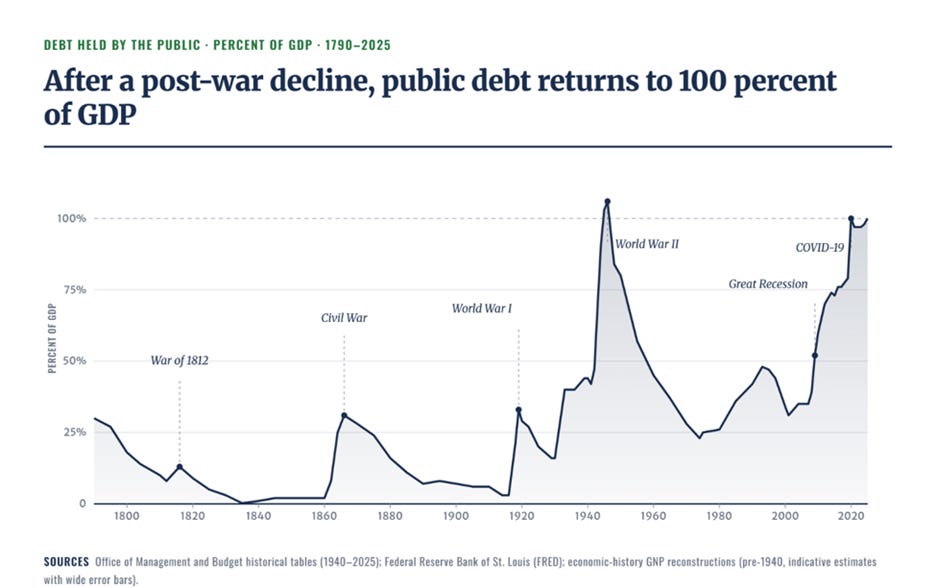
As we have written repeatedly, the United States’ fiscal situation is expected to only worsen. Publicly held debt to GDP already is at historical levels, and absent change, it is expected to rise to a massive 175 percent by 2056. Unless there is a return to the Hamiltonian norm, Americans can expect some painful combination of austerity, higher taxes, and inflation in the future.
The New Center for Strategic Fiscal Reform
The Fiscal Lab launched a new program this past week: the Center for Strategic Fiscal Reform (CSFR). This program builds on a Washington institution, the Center for Strategic Tax Reform, that conducted monthly seminars on tax and fiscal issues for over 40 years. That Center nurtured many of Washington’s most important tax reform achievements of the past half century and is widely credited with lowering the tax burden on investment and innovation.
Like the earlier Center, CSFR will initially sponsor monthly seminars, but its focus will be much more on policy changes to enhance fiscal stability and economic growth than on changes to the tax code. The Center will be wholly housed inside the Fiscal Lab, which should encourage discussion across political parties of steps to stabilize federal finances. CSFR also will be keenly interested in research on how better to measure the effects of federal spending on the social and economic dimensions of American life. In that vein, improving the measurement agencies of Congress, principally the Congressional Budget Office (CBO) and the Staff of the Joint Committee on Taxation (JCT), will be a regular seminar topic.

Our inaugural meeting was a great success. About 45 people attended, and they were just the type of influential individuals you would want associated with this important undertaking. CSFR’s next meeting will be in September.