

Fiscal Lab Notes is the official Substack page for the Fiscal Lab on Capitol Hill. You can check out all our work and analyses at fiscallab.org.
A Handy Dandy Guide for Working with CBO
A Congressional Budget Office (CBO) score gives Members of Congress, their staff, and the public an assessment of what a bill costs. Certain bills require scores, and even those that don’t typically benefit from having a score, as it informs the drafting process and adds a level of credibility as Members try to garner support for their legislation. Unfortunately, the scoring process can be a source of ire as scores frequently involve technical jargon and assumptions, which can be difficult to understand.
The scoring process starts when a congressional office sends a scoring request letter to CBO. A well-written letter communicates specifically what a Member’s questions are and what variables should be considered in the analysis and increases the likelihood of receiving a helpful score. By contrast, a poorly written letter could delay the scoring process and result in a score that does not adequately address the Member’s questions.
To help Members and their staff, Michael Schultz has written a guide with step-by-step instructions for how to write a request letter to CBO. A good letter will flesh out exactly whether the Member wants a conventional score, a dynamic score, or both and what variables should be considered. It will also ask for a kickoff meeting as well as check-in dates to ensure the Member’s office and CBO are on the same page. Schutlz also includes a letter requesting a score of a fun hypothetical bill, H.R. 1776, the Grand Annual National Independence Day Universal Ice Cream Distribution, Commemoration, and Patriotic Dessert Access Act, to show what a good letter looks like.
This practical guide is essential reading for any staffer who is new to the scoring process.
AI and Labor Markets
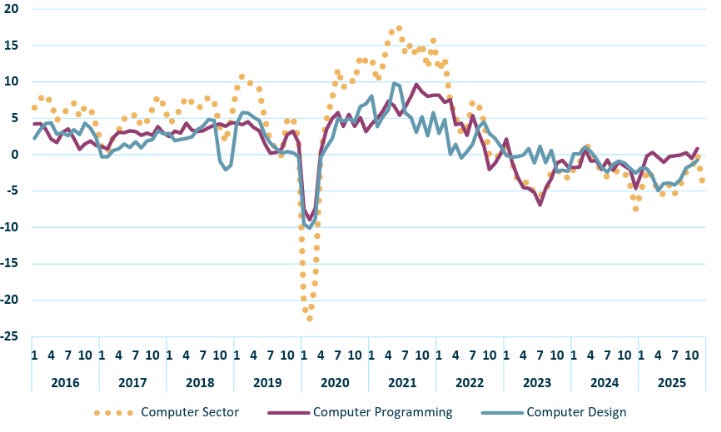
In his latest EPIC report, Bill Beach reviews the generally positive BLS jobs report for March. He also digs deeper into tech sector data, and asks “Is artificial intelligence wiping out jobs in the tech sector or transforming it?” As seen in Figure 1, Beach observes dramatic reductions in employment in computer programming and computer design over the past two years. These trends substantiate anecdotes of large companies including Amazon and Block laying off workers because of productivity gains. However, Beach also observes that AI has not yet had substantial effects on overall productivity and economic activity. How do we answer this seeming paradox? Beach argues the tech firms overhired during the pandemic, and corrections “have been underway since 2022” and began before AI began to affect coding later in 2023 and 2024.
Figure 1. Employment Change in Computer Systems Sector, Programming, and Design, 3 month moving averages, March 2016 – March 2026 (in thousands, seasonally adjusted)
Source: Economic Policy Innovation Center (EPIC)
While AI is now replacing coding personnel, Beach argues it will lead to staff (in tech and beyond) strengthening after a transition period where AI is “integrated into production processes.”
How the U.S. Income Tax Grew
In case you missed it, Joe McCormack wrote a brief overview of the history of the income tax earlier this week in honor of Tax Day.
McCormack points out that the federal income tax, which started in 1913, was initially much smaller and applied to a much narrower base than it does today. However, as the size of the federal government grew, taxation on income grew too. He points out:
Over time, Washington transformed the system from a limited tax on a relatively small number of wealthy taxpayers into a far broader, mass tax system, especially as withholding, payroll taxation, and postwar expansion made federal taxation a routine part of working life for millions of households.
Despite the expansion of the income tax, federal spending has outpaced revenue. On average over the past 40 years, the federal government “has spent roughly 3.8 percentage points of GDP than it typically collects.” This spending problem has contributed to mounting deficits. While some economists argue that the solution is more revenue, McCormack cautions that higher taxes can harm economic growth by discouraging work, saving, and investment. Rather, Congress needs to prioritize a reduction in spending.