

Fiscal Lab Notes is the official Substack page for the Fiscal Lab on Capitol Hill. You can check out all our work and analyses at fiscallab.org.
Last Wednesday, April 15, was the dreaded tax deadline, the day Americans are reminded how much of what they earn is claimed before they ever see it. For some, that means rushing to file on time and then writing yet another check to the federal government instead of receiving one. For others, a refund may feel like relief, but it is really just the return of their own overpaid tax dollars after giving Washington an interest-free loan. And for many workers, that annual reckoning comes only after seeing money already stripped from each paycheck—federal withholding, payroll, Social Security, Medicare, and often state and local taxes leaving them with far less than what they actually earned. How did the country get here, and how did today’s tax system become such a permanent, and frustrating, feature of American life?
The modern federal income tax began in 1913, not as a World War I measure, but as part of a political and fiscal shift away from heavy reliance on tariffs. After ratification of the Sixteenth Amendment, which established Congress’s power to impose a federal income tax without apportioning it among the states, Congress passed the Revenue Act of 1913 and created a new source of federal revenue tied directly to income. At first, the system was far narrower than what Americans live with today. Because of generous exemptions and deductions, less than 1 percent of Americans paid only 1 percent of taxes on net income. Simply put, the original income tax was aimed at a relatively small, higher-income slice of the country rather than the broad middle class. However, over time, as the federal government expanded, it repeatedly widened the tax base, reaching more households, more forms of income, and more economic activity. What began as a narrow tax on only the wealthiest individuals gradually evolved into a cornerstone of federal finance. Once that process existed, it was then far easier for Washington not only to raise rates, but also to widen the base, exposing more of the economy to taxation.
The expansion and revisions of income tax rates changed dramatically over time, but so did the tax base itself. The top federal income tax rate that began at just a few percent, rose sharply during World Wars I and II, and eventually climbed above 90 percent in the immediate postwar era before falling, over later decades, to far lower levels today.
However, for much of the income tax’s early history, the tax base was narrower, fewer households faced the tax, and the top rates applied only at extremely high-income thresholds. Over time, Washington transformed the system from a limited tax on a relatively small number of wealthy taxpayers into a far broader, mass tax system, especially as withholding, payroll taxation, and postwar expansion made federal taxation a routine part of working life for millions of households.
To better “sell” this income tax, not as a legal obligation, but as a patriotic duty, the Treasury Department even enlisted the help of former service member Donald Duck to boost tax compliance. In 1942, Disney’s The New Spirit, depicted Donald overcoming his reluctance in paying his income taxes once he learns that his tax dollars provide military equipment to defeat the Axis powers. This short film was highly effective because many Americans at the time believed their tax dollars were tied directly to national defense and a common purpose.
Today, that sense is badly weakened if not lost entirely. For many taxpayers, Washington no longer acts like a careful steward of public sacrifice; instead, it looks like a government that piles on debt, and fritters away tax dollars without producing results that clearly improve American life. This frustration is reasonable. Household budget data show growing spending and debt as many Americans struggle to buy homes and meet higher everyday costs, while the federal government continues to run massive trillion-dollar deficits.
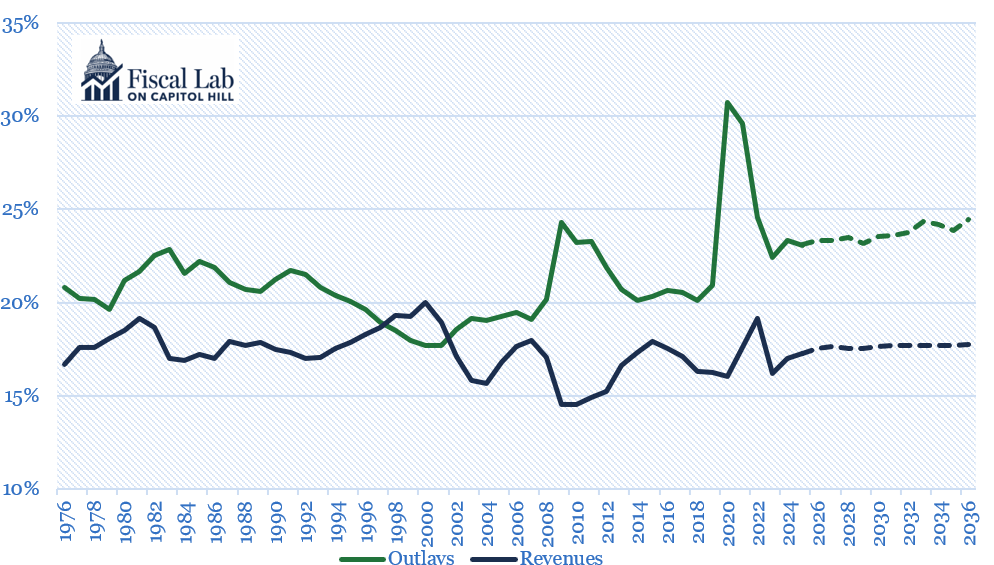
While federal revenues have moved up and down over time, as a share of GDP they have generally stayed in a fairly narrow historical range. As shown in Figure 1, over the past 50 years, revenues have averaged about 17.3 percent of GDP, while federal outlays have averaged about 21.1 percent of GDP. In other words, Washington has historically spent roughly 3.8 percentage points of GDP more than it typically collects. That is the core fiscal problem: The federal government has built a spending structure that persistently runs ahead of what the tax system has historically produced. The country’s fiscal problem is not simply that revenues are too low. Rather, spending has outgrown the nation’s normal tax base.
Figure 1. Government revenues and outlays (and forecasts) as a percent of GDP
Citation: Budget and Economic Data | Congressional Budget Office
While some commentators have nostalgically argued that a return to the higher taxes of the World War II and postwar era would be a solution to our deficit problem, such calls should be met with skepticism. History shows that what began as a narrow tax aimed at a small number of wealthy Americans did not remain narrow for long. Over time, it expanded into a far broader and more permanent burden that reaches deep into the paychecks and working lives of ordinary Americans. Nor are higher marginal tax rates economically costless. The Congressional Budget Office has noted that higher marginal tax rates on labor income tend to reduce hours worked, while the Tax Policy Center has similarly explained that high marginal tax rates can discourage work, saving, investment, and innovation. Congress needs to reform its addiction to spending before imposing additional burdens on everyday Americans through higher taxes.
That is also why supposedly one-time tax policies, such as a wealth tax, should be approached with extreme caution. Once the mechanism exists, history suggests it can be expanded well beyond its original design. So, while higher taxes may raise more revenue for a period of time, they can also weaken the economy that produces that revenue in the first place. If Washington wants to demand more from taxpayers, it should first prove it can spend with discipline and purpose. Otherwise, Americans are left with the worst of both worlds: a heavier tax burden and a government that still cannot live within its means.