


Fiscal Lab Notes is the official Substack page for the Fiscal Lab on Capitol Hill. You can check out all our work and analyses at fiscallab.org.
Nearing the calendar year’s end, those deeply concerned about the nation’s fiscal situation can find themselves a bit glum. Yet this year, they may be forgiven for feeling at least a little more festive than usual. It’s less about what Congress is doing, and more about what Congress is not doing at this time of year.
In recent years, the norm has been for Congress to miss the September 30 fiscal‑year deadline for enacting discretionary government‑funding appropriations and to work under a government‑funding resolution that expires right before or during the holidays. Continuing resolutions (CRs) for fiscal years 2023, 2021, and 2019 are typical of this. Members of Congress aren’t that different from the general public, and they too want to be home for the holidays. End‑of‑year deadlines increase the probability that funding within the bills won’t be as deeply scrutinized, with some questionable funding included. While continuing resolutions are not ideal fiscal practice, the November 12, 2025, continuing resolution placed the measure’s expiration on January 30, 2026. Hence, an end‑of‑year spending blowout is less likely for 2025.
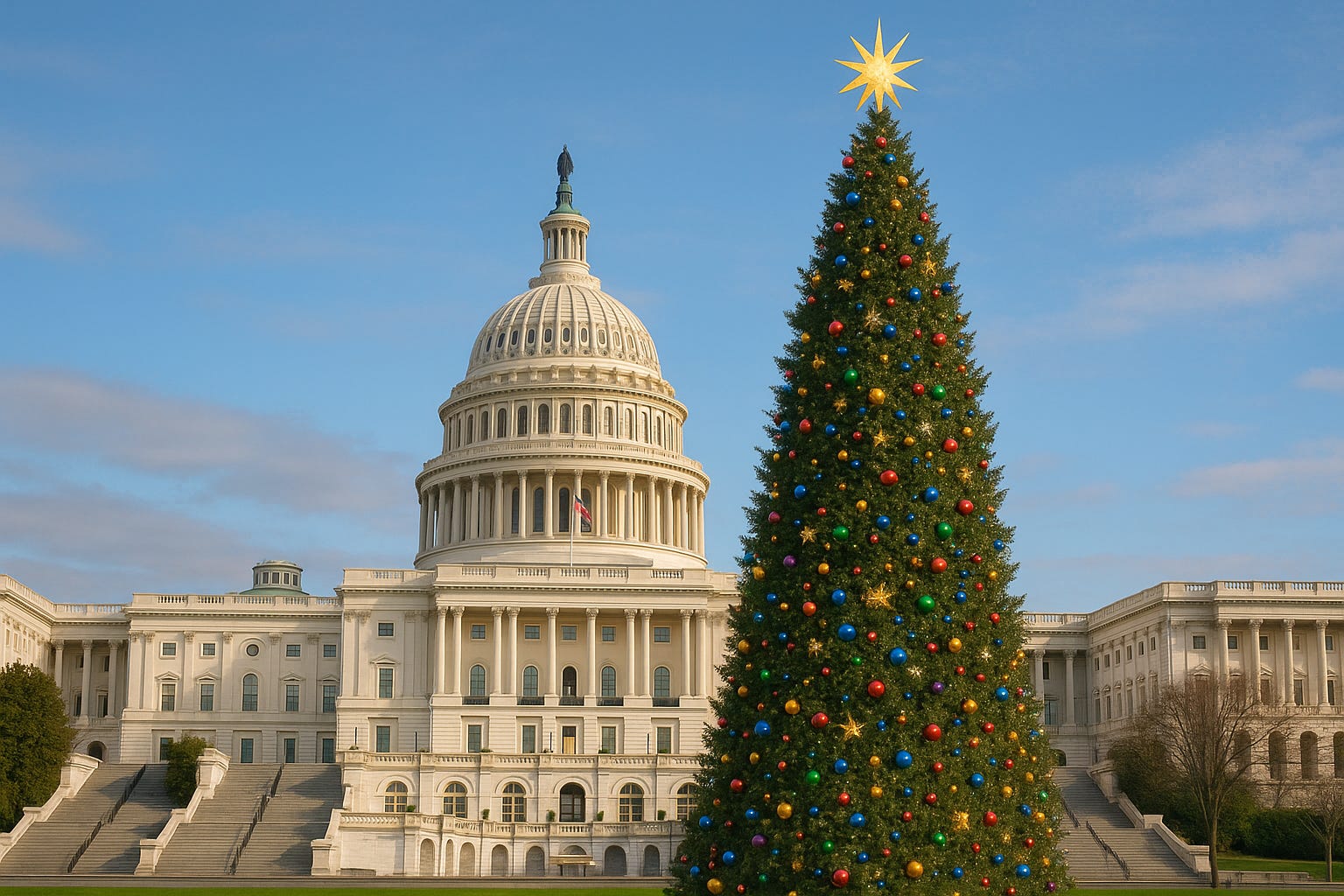
Still, both the House and Senate are scheduled to remain in session until December 18 and 19, respectively, and this closing period of 2025 will be busy. Besides Congress taking up the National Defense Authorization Act (NDAA), Senate Democrats will also get their chance to vote on their preferred Affordable Care Act (ACA) Covid‑credit extension legislation—a vote that was promised as part of the reopening of government on November 12. This is a partisan measure, for a partisan policy, for which the Government Accountability Office (GAO) found extensive and persistent fraud risk just last week. The Democratic measure seems doomed to fail in the Senate, and it is unlikely that any Republican counterproposal will have sufficient support to pass or reach President Trump’s desk. Funding for these Covid credits seems likely to lapse.
Besides the NDAA and Covid‑credit votes, the end of 2025 also promises to be busy with Senate confirmations and various other proposals that will affect the nation’s fiscal future. The Fiscal Lab on Capitol Hill is keeping a close eye on all of this, as well as providing analytical and educational support for Congress when it returns in January to finish work on FY2026 appropriations measures.
Next week, we’ll be back with our final Weekly Lab Report of 2025. We’ll be discussing CBO transparency, the state of U.S. labor markets, and more—so don’t miss it!