

The federal debt limit, the statutory limit on the government’s borrowing, is an important fiscal policy issue that Congress must again grapple with in 2027.
Last month, the Fiscal Lab’s Matthew Dickerson presented to Senate and House staffers on the mechanics and importance of the debt limit.

Senior Fellow Matthew Dickerson discusses the debt limit with Senate staffers.
Dickerson reviewed the history of congressional borrowing and the modern debt limit, which began in 1939. The debt limit is a tradeoff: Congress maintains a statutory constraint over how much debt may be issued, while the Treasury controls day-to-day debt management. Importantly, the debt limit does not increase borrowing per se, but it gives the Treasury borrowing authority to finance obligations enacted by law.
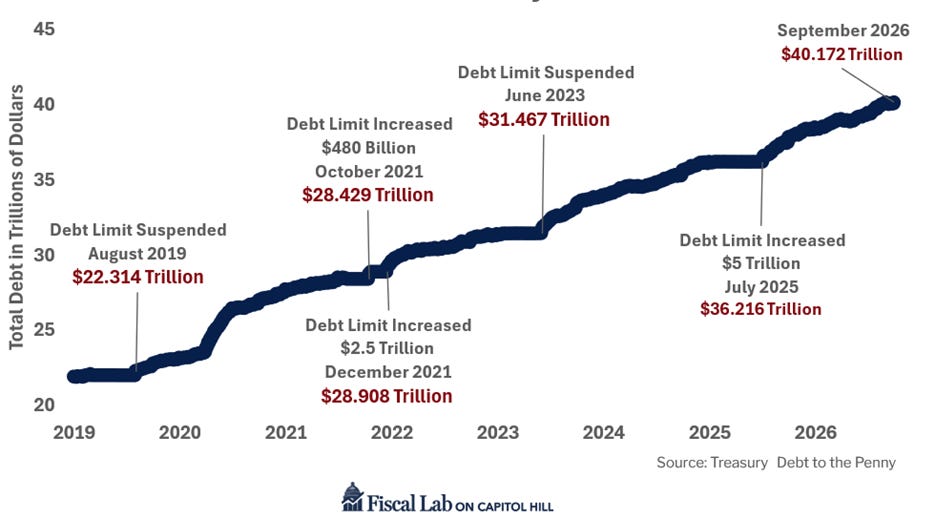
As shown in Figure 1, the national debt has skyrocketed in recent years, rising nearly $18 trillion in the past seven years, from $22.314 trillion in August 2019 to $40.172 trillion in September 2026. Since Congress runs very large deficits with no offsetting surpluses, the debt continues to rise, forcing Congress to regularly either suspend or increase the debt limit.
Figure 1. Total federal debt
Dickerson explained how the “contact date,” the date the government reaches the debt limit, differs from the “X-date,” the date the government exhausts its ability to meet its bills, including military pay, Social Security, contractor wages, and interest expenses in full and on time.
When the government reaches the contact date, it can draw from three main resources to meet its obligations. First, it can use cash it has on hand in the Treasury General Account (TGA), the government’s checking account held at the Federal Reserve Bank of New York. Since daily federal revenue and expenditures fluctuate dramatically, the future TGA balance is the most significant unknown variable in projecting the contact and X-dates. Second, the government still receives revenues through tax payments, which also change drastically from month to month. Third, the Treasury can use what are called “extraordinary measures,” specifically accounting and debt management measures authorized by Congress. For instance, the Treasury can suspend investments in federal retirement funds like the Thrift Savings Plan’s G Fund.
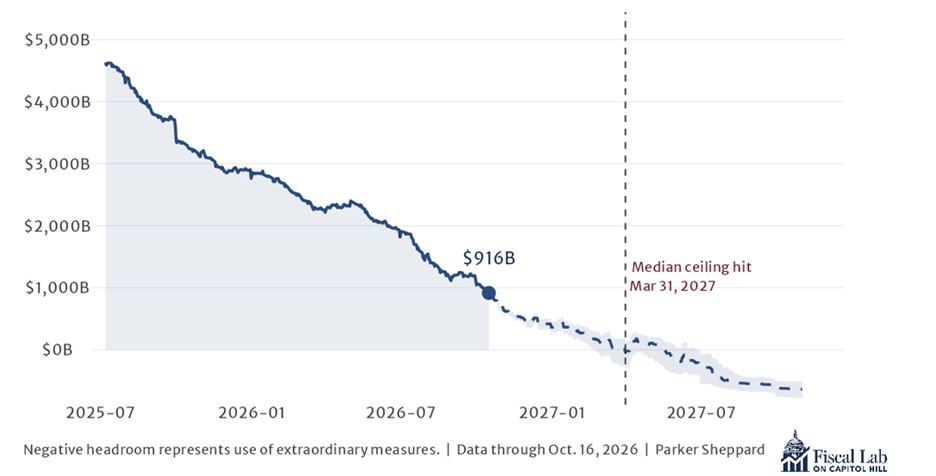
The cash flow of the federal government can fluctuate unpredictably, so projecting the contact date and X-date is difficult. The Fiscal Lab’s Parker Sheppard has simulated both dates and found a median contact date of March 31, 2027, and X-date of November 1, 2027 (see Figure 2).
Figure 2. Remaining debt issuance headroom—statutory debt limit minus debt subject to limit since July 4, 2025
The Treasury makes hundreds of billions of dollars of payments each week. If the federal government reaches the X-date, it will default on at least some of its obligations. Such a default could be devastating to financial markets because it would undermine Treasury debt’s status as the world’s safe asset. This shock to financial markets, along with the disruption to others owed federal money, could easily plunge the American and world economies into recession.
Nevertheless, Dickerson argued that there is real value in having a debt limit. The most significant deficit-reduction agreements of the past four decades all took place as part of debt limit increases. For example, the 1985 Gramm-Rudman-Hollings Balanced Budget and Emergency Deficit Control Act established deficit targets through sequestration (across-the-board spending cuts). The 1990 Budget Enforcement Act established discretionary spending caps and pay-as-you-go (PAYGO) rules, which required projected deficit increases to be offset by equivalent amounts of spending cuts or revenue increases. More recently, the 2011 Budget Control Act imposed new discretionary spending caps and resolved a major debt limit debate.
Dickerson emphasized the importance of returning to the Hamiltonian norm, Congress’s historical commitment to defend the integrity of Treasury debt by balancing previous deficits with future surpluses. Hopefully, Congress will use next year’s debt limit discussion to return to this norm by coupling raising the debt limit with meaningful deficit reduction.