


Fiscal Lab Notes is the official Substack page for the Fiscal Lab on Capitol Hill. You can check out all our work and analyses at fiscallab.org.
The Fiscal Lab launched in September 2025. As we approach our six-month anniversary, we want to reflect on what we have done and discuss what is on the horizon.
The Problem
The fiscal condition of the federal government continues to worsen, despite billions spent supporting the election of deficit reformers in both parties, millions spent on think tanks that have produced thousands of policy papers condemning fiscal malfeasance, and the warnings of hundreds of the world’s foremost financial experts and economists that the fiscal path we walk now leads only to disaster.
Despite all of this, our fiscal condition is worse today than a year ago and seems worlds away from the days when federal debt was little more than a third the size of the US economy. Today, total federal debt is larger than the largest economy in the world. Publicly held federal debt increased from $17.2 trillion at the end of the first quarter in 2020 to $30.2 trillion at the end of the fourth quarter in 2025, which is an increase of 76 percent over just five years. While revenues are healthy and continue to grow, they have not exceeded spending since 2001.
Clearly, what we have been doing to turn the tide of red ink has not worked, and it is past time to change our strategies. Only Congress can make the big policy pivots needed to alter our fiscal course, but the Article One branch of government has grown weaker in its abilities to address fiscal problems. One reason for this decline is the capacity of senior Hill staff to sustain reform efforts from one Congress to another, which has fallen dramatically as growing turnover and declining analytical skill levels have hallowed out their collective policy knowledge. Another reason is the greater time elected Members spend raising campaign funds compared to thinking about policy reforms.
Our Launch
It was against this backdrop that the Fiscal Lab on Capitol Hill was founded. The Lab is designed to work behind the scenes in Members’ offices to provide state-of-the-art analysis of proposed legislation, budget scores that compete with those provided by the Congressional Budget Office (CBO), and relevant, highly focused training to mid-level and senior staff. Lab staff sit with Members and their legislative directors to provide analytical assets to support good fiscal proposals (however broadly or narrowly focused) so that no idea that improves our fiscal condition dies for lack of analytical attention. At the same time, Lab staff provide data and arguments that demonstrate how key program reforms that slow down deficit growth can also produce broadly shared economic and social benefits.
Thanks to our generous funders and stakeholders, we launched the Fiscal Lab on September 15, 2025. Our website announced our presence on that date, which we punctuated with a blitz of Hill visits organized by our Senior Fellow and Director of Strategic Outreach, Doug Branch. Those visits to House and Senate offices resulted in several projects and promises to work with the Fiscal Lab on a wide range of legislative initiatives. Note that we decided to launch over a 30-day period that we expected would contain the normal fiscal year-end drama of past years. Little did we know that our launch would coincide with the longest cessation of governmental activity in history. Honestly, the government shutdown was an excellent backdrop for highlighting the many reasons why we launched the Fiscal Lab.
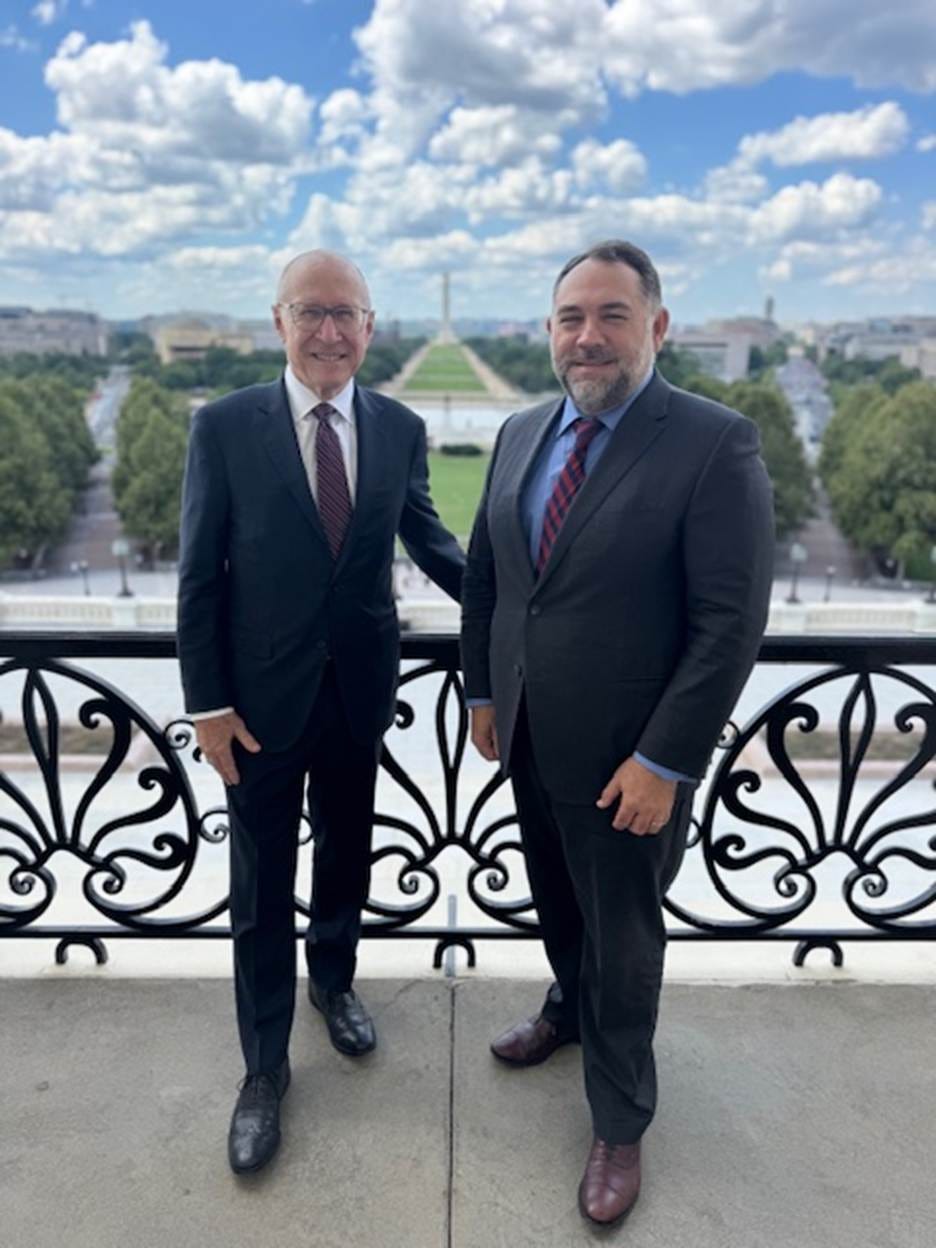
Fiscal Lab Executive Director William Beach and Director of Strategic Outreach Doug Branch on the “Speaker’s Balcony” in Fall 2025.
Our First Projects
No sooner had we announced our arrival, however, than Doug secured an amazing assignment: the Republican Study Committee (RSC), the largest Republican caucus in the House, asked the Lab to score over 100 provisions (basically separate pieces of legislation) in what would become the House’s second reconciliation bill, (or Reconciliation 2.0). Organizations far larger and well established would have found the challenge of scoring these separate pieces of legislation in six weeks daunting, to say the least.
Even so, the Fiscal Lab accepted the opportunity. We did what the Lab was built to do: work closely and behind the scenes with Members and staff to refine and analyze legislation designed to walk the federal budget back from the fiscal crisis cliff. Under the direction of Joseph McCormack, one of the Lab’s Senior Economists, Patrick Horan and Bill Beach worked steadily on all 108 separate policy initiatives.
Six weeks later, the lab produced conventional 10-year scores that closely followed the scoring template of the CBO. We decided to follow a number of CBO scoring conventions in order to make it easier for House leadership to use our analytical work in obtaining useable scores from CBO. These conventional scores then appeared in the RSC’s publication, “Making the American Dream Affordable Again.” The Lab now is working on a dynamic scoring analysis of Reconciliation 2.0 under the direction of Parker Sheppard. That is, how would the US economy react if Congress were to enact the provisions contained in the RSC’s document of January 13, 2026.
While Lab staff were providing the RSC with detailed budget scores, other offices asked us for analytical support. Lab staff have worked on several bills to reform federally supported healthcare, trade policy, apprenticeship and other work policy programs, and means-tested welfare policies. Anyone who visits www.fiscallab.org might find value in our policy papers and opinion essays, but the analytical work connected to legislation is reserved for elected Members of Congress.
Educating Congress
Our legislative analysis work is only one half of our Hill initiatives. The Lab’s other major mission is Hill staff education. We believe that solving our fiscal crisis will require Members and Hill staff who are much better educated about how deficits affect the economic and financial performance of the private sector. It requires, as well, Hill staff who are better prepared to work with the Congress’s official analytical agencies: the Congressional Budget Office, the staff of the Joint Committee on Taxation, and the Congressional Research Service.
To that end, the Fiscal Lab brought Michael Schultz on board as our Project Manager to coordinate the growing portfolio of Lab activities. With Schultz’s help, the Lab conducted its first Hill training session over three weeks starting on January 16: “CBO 101: Understanding the Baseline Budget & Economic Outlook, Scoring, and Transparency.” The House Committee on the Budget supported the Lab’s training work. CBO exerts enormous influence over the pace and content of House and Senate Legislation. Unfortunately, many Members and staff do not know how best to work with CBO or evaluate the agency’s work. Thus, many opportunities for better legislation and crisper analysis are left untapped.
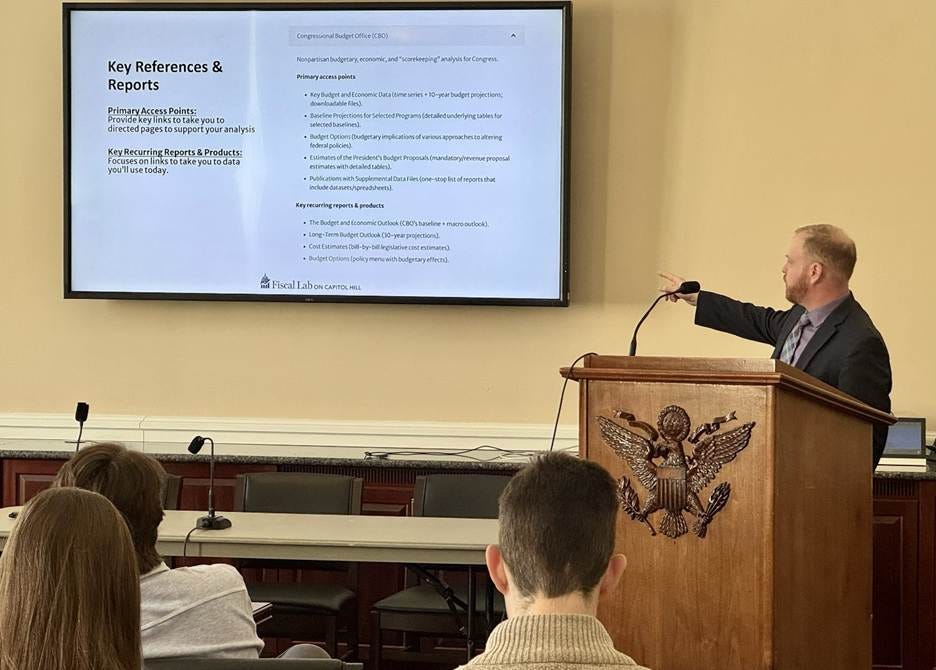
Fiscal Lab Senior Fellow Joe McCormack presenting to congressional staffers on “CBO 101”
The mid- to senior-level staff who attended these sessions learned about the history of budgeting, the administrative workings of the CBO, and how to write a request letter to the CBO. More importantly, they learned about the models and scoring techniques that CBO uses. It is crucial that staff who work with CBO (or its tax scoring counterpart, the staff of the Joint Committee on Taxation) be able to use the language of budget analysis. Students also had ample time to improve their statistical and Excel skills. The Lab instructors taught these staff how to take CBO budget forecasts and modify the assumptions about economic growth rates and changes in prices. These applied or lab sessions were the most popular part of the course.
New Courses in 2026
In addition to our scoring, congressional seminars, and policy papers, the Fiscal Lab is now planning new courses this year in basic economics and statistics, in how to work with the Joint Committee on Taxation, on trade and tariff policies, and on immigration. We are exploring partnerships with several universities to enhance these courses through college credit opportunities for Hill staff. The Lab has launched a YouTube channel where we provide videos of our events. It will also offer on-demand courses on topics crucial to building capabilities equal to the mighty task of changing our country’s fiscal direction.
Stay tuned!