

The war in Iran raises many questions, but some of the most pressing address the immediate and longer-term effects on the US and global economies. About 20 percent of the world’s oil flows through the Strait of Hormuz, much of which goes to Asian economies. China gets 30 percent of its crude oil from oil producers, including Iran, that line the coasts of the Persian Gulf. While Europe and the Americas are not nearly as dependent, increases in oil prices caused by Persian Gulf oil shipping disruptions could cause gasoline prices to rise in places as distant from Iran as Lander, Wyoming, and Grapevine, Texas. Spikes in oil prices have caused severe recessions in the past, and there’s no guarantee they won’t do that again.
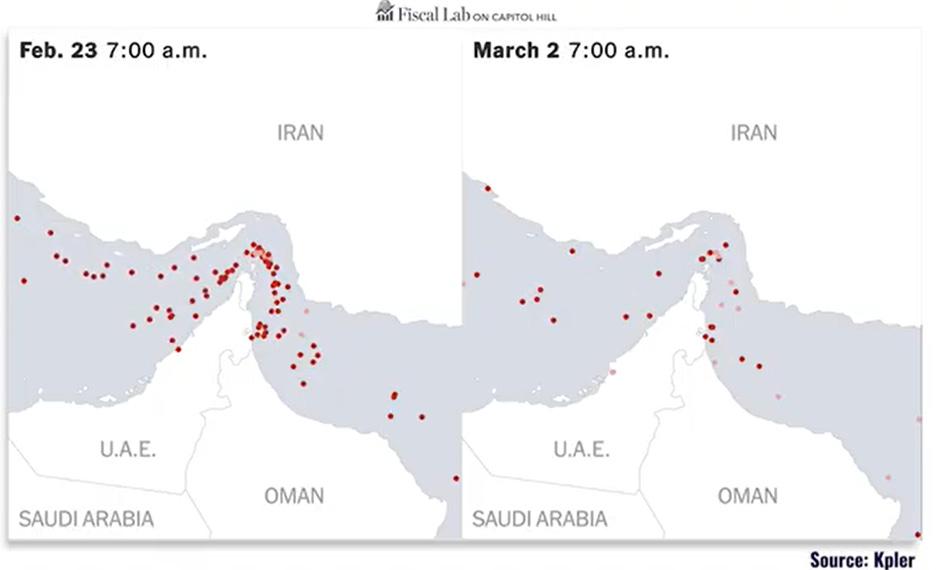
Source: “How War in the Middle East is Choking Off the World’s Oil and Gas,” New York Times, March 3, 2026
So, what could happen to the U.S. economy if oil is prevented from flowing out of the Persian Gulf because Iran closes the Strait of Hormuz? Patrick Horan interviewed me on this very topic.
Based on previous simulations conducted in a war game setting, the US economy would suffer significant output and employment losses, unless Congress working with the administration and the private sector adopt policies that mitigate those losses.
The war game simulations conducted by others at the Heritage Foundation and me in 2007 and 2008 involved circumstances remarkably like the current conflict with Iran. The first game assumed that Iran retaliated to partial destruction of their nuclear weapons program by the United States by, in turn, destroying collection and refining capabilities in Saudi Arabia, as well as effectively closing the Strait of Hormuz.
These assumed moves by Iran led to these results (dollar amounts for GDP and disposable income brought forward to 2025 values):
· a doubling of crude oil prices in the first month of the conflict, from about $80 per barrel to $150;
· a decline in real Gross Domestic Product of about $240 billion in the year following the start of hostilities;
· a drop in real disposable income of $372 billion over the same period;
· and a decline in nonfarm employment of 1 million jobs by the end of the first six months.
The second game involved a similar crisis where terrorist attacks caused the closing of the Straits of Hormuz as well as Malacca between Indonesia and Malaysia and led to similar results.
Of course, these are the adverse effects that would flow from the scenario above if little effective mitigation occurred. Given that today’s circumstances are remarkably similar to the war games of 2007 and 2008, the point of surfacing simulation results of nearly 20 years ago is straightforward: Actions to reduce the harmful domestic and global economic effects need to start now while the inventory of world crude oil supply is high. Daily shipments of crude oil worldwide average around 80 million barrels per day. It won’t take long before a protracted conflict in the Persian Gulf will start draining the energy out of the world’s leading economies.
The gamers in 2007 and 2008 argued that many of the adverse economic effects could be mitigated if not eliminated through temporary tax policy changes, temporary regulatory relief (particularly with respect to CAFE standards and clean air regulations), emergency income assistance for affected populations, and a rapid increase in military spending that would have an economically stimulative effect.
Policymakers today might make different decisions. The point is that decisions need to be made and made promptly.