

Fiscal Lab Notes is the official Substack page for the Fiscal Lab on Capitol Hill. You can check out all our work and analyses at fiscallab.org.
A 3 percent deficit-to-GDP target has become a popular proposal for stabilizing the national debt. The idea has been endorsed by the House Budget Committee and enjoys bipartisan.
Last week, William Beach and Park Sheppard spoke on Sheppard’s recent Fiscal Lab paper on this proposal.
The total federal budget deficit equals the primary deficit (the deficit excluding interest rate payments) plus interest payments to service the existing federal debt. Long-run economic growth and the real interest on federal debt have both averaged about 3 percent. As Sheppard explains, a total 3 percent deficit target is therefore a natural anchor because it would roughly balance the primary deficit. Congress would fund its noninterest spending from revenue, while it would borrow to cover interest expenses.
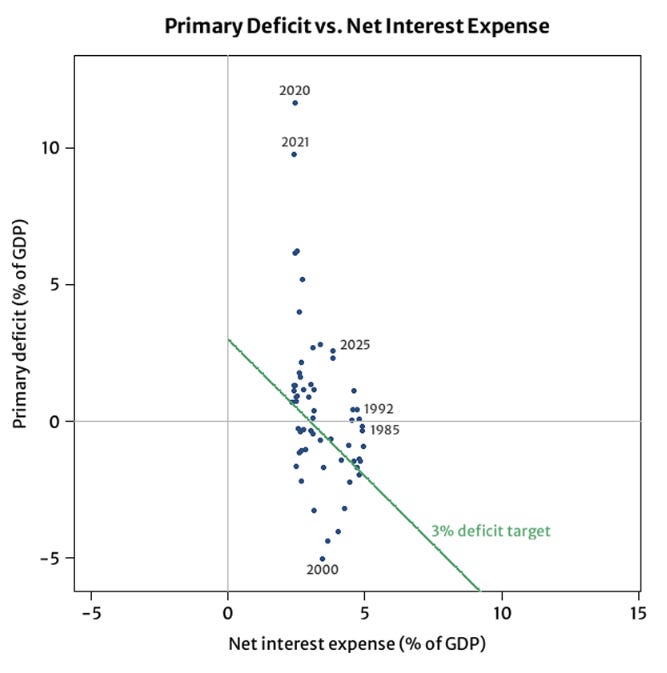
Currently, the federal deficit is about 6 percent of GDP, so a 3 percent target may sound difficult to achieve. However, deficits of roughly 3 percent are not unusual by historical standards. Congress has achieved a deficit near this level in 20 of the past 60 years. Figure 1’s green line shows the combinations of primary deficits and net interest expenses consistent with a 3 percent total deficit. Sheppard also argues that a 3 percent target is much more practical than a completely balanced budget. To completely balance the budget would require very steep cuts, which Congress is unlikely to commit to. It is better to pick a realistic goal that Congress can adhere to than an ideal goal it will give up on.
Figure 1. Primary deficit vs. net interest expense, 3% deficit constrain
How would the US achieve this target? While theoretically either an increase in revenues or a decrease in outlays would reduce the budget deficit, Sheppard cites a recent study indicating that the US is already close to the top of the “Laffer curve,” the revenue-maximizing tax rate. Therefore, the US is much more likely to see a deficit reduction primarily in the form of spending cuts.
Listen to the whole interview!