


Fiscal Lab Notes is the official Substack page for the Fiscal Lab on Capitol Hill. You can check out all our work and analyses at fiscallab.org.
This week we look at two sides of the same problem—as well as the work we are doing to address it. In his latest analysis of the July jobs report, Bill Beach highlights that the labor force is shrinking, with fewer Americans working or looking for work than at any point since February. A smaller labor force may still support a rising standard of living, but only if those who remain can maintain a higher level of productivity. This raises an important question our statistical system cannot currently answer: Is AI actually making American workers more productive? The second half of this issue covers the Fiscal Lab's research project to build a measurement framework to answer this increasingly pressing question.
Cooling Labor Markets
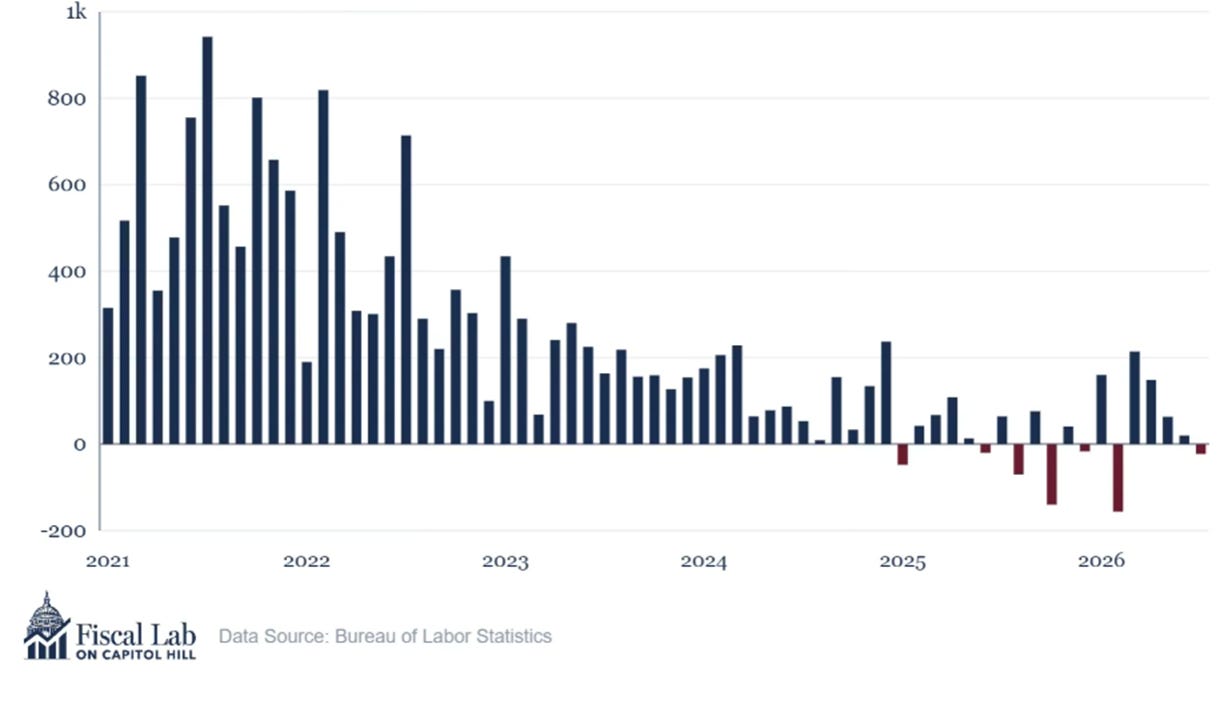
Last week, Bill Beach reacted to the Bureau of Labor Statistics’ (BLS) July 2026 Employment Situation. The 23,000 decline in total nonfarm payrolls garnered the most media coverage, but the underlying data point to something more persistent than a single bad month.
Beach pointed to two other sets of numbers—downward revisions and slowing labor force growth—as further indicators of labor market softening. In addition to estimating negative job growth for July, BLS reduced May and June job growth from 129,000 to 63,000 and 57,000 to 20,000, respectively. We can see the slowdown in monthly job growth below in Figure 1.
Figure 1. Monthly Change in Total Non-Farm Payroll Employment (In Thousands)
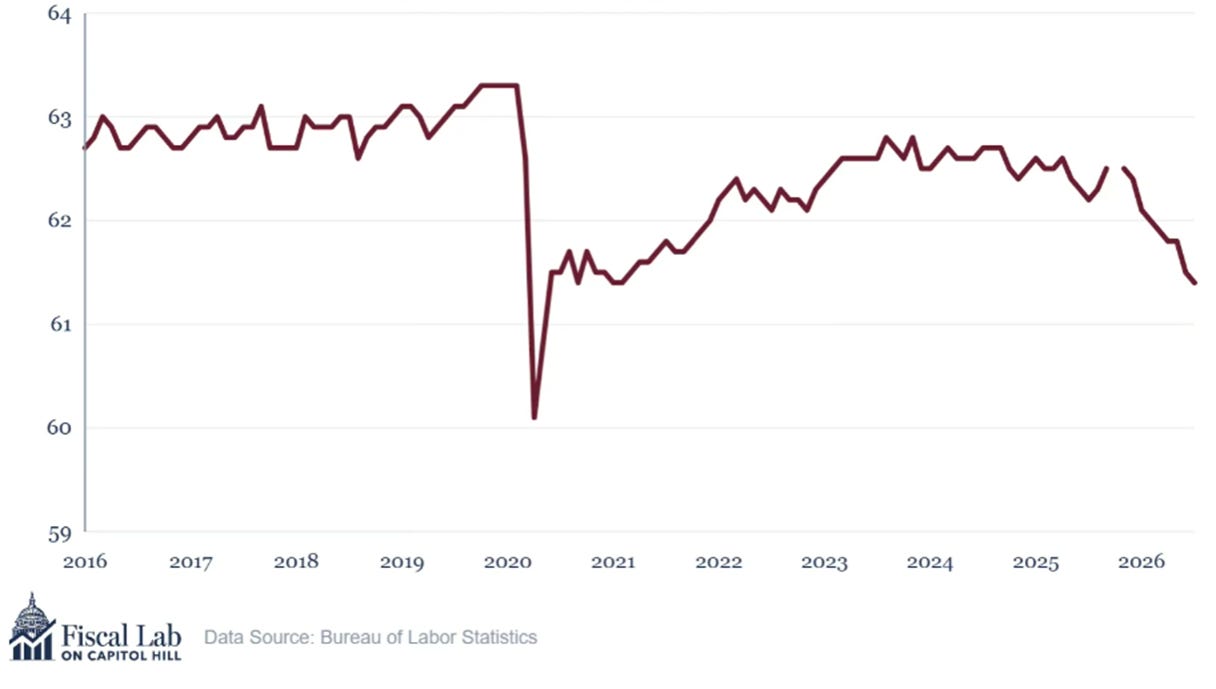
Beach cited several examples of declining labor force participation. Since February, the civilian labor force has fallen by 1,371,000, and the labor force participation rate has dropped 0.63 percentage points to 61.4 percent (as shown in Figure 2). This trend is alarming because, as Beach pointed out, "the decline means that those who continue to participate need to be achieving ever greater levels of productivity to ensure growth in the nation's standard of living."
Figure 2. Labor Force Participation Rate (Percent of the Civilian Population)
National Task Classification
As highlighted in our latest labor report, a shrinking labor force places increasing emphasis on our ability to maintain and increase productivity. But the wave of AI technology potentially driving productivity gains is not currently captured in our official productivity statistics. Without a reliable way to measure the transformation of work at the task level, we cannot accurately gauge whether AI is delivering the productivity gains necessary to offset the shrinking labor force. AI is only the latest technological revolution to highlight this problem in productivity measurement. In the early 1990s, economists underestimated the productivity gains from desktop computing and consequently misjudged how fast the economy was actually growing.
We are increasingly convinced that the solution to this problem lies in the development of a national task classification system. The Fiscal Lab has spent much of the summer architecting just such a system that statistical agencies can implement to measure work at this level. We have had several productive meetings on the subject with both government and private sector groups, and there is a real and growing interest in this statistical measurement effort. Although there are a number of potential paths to building such a task classification system, there is a strong consensus that the currently available data are not adequate to answer the questions Congress is already asking about AI and jobs.
We propose that the federal statistical bureaus pursue the most expedient path to implementing task-level measures by building on existing sampling frames. Through the Quarterly Census of Employment and Wages, the federal government already collects data from millions of employers covering more than 95 percent of American jobs. Adding a set of questions about tasks to what already exists would allow us to follow changes at the task level up through occupations and industries to productivity. For a relatively small sum, policymakers would gain a much clearer view of what AI is actually doing to work.