

Fiscal Lab Notes is the official Substack page for Fiscal Lab on Capitol Hill. You can check out all our work and analyses at fiscallab.org.
This week Fiscal Lab released its own suite of budget models and put them to good use to score all 110 bills and proposals in the Cost-of-Living Healthcare Working Group’s memo. We also cover Doug Branch’s new op-ed in The Hill on the fiscal test facing the incoming Congress.
Open, Fast Scores for Every Office
Far too many bills in Congress never get a cost estimate. Fewer still get one in time to be of any use. The Congressional Budget Office (CBO) and the Joint Committee on Taxation (JCT) usually score a bill only after a committee requests it. By then the estimate arrives as a single number, and the chance to test alternatives has almost certainly passed. If information is power on Capitol Hill, then this failure to give all (or even most) bills a score is a major power drain. Good ideas to relieve our fiscal stress could easily die for lack of analytical attention.
Fiscal Lab is working to change that. This week Senior Fellow Drew Gonshorowski announced the Lab’s new modeling suite: six models that the Lab developed and will run independently, each checked against CBO’s baseline or the programs’ own data. See the full suite below in Figure 1.
Figure 1. Fiscal Lab’s six budget models and what each estimates
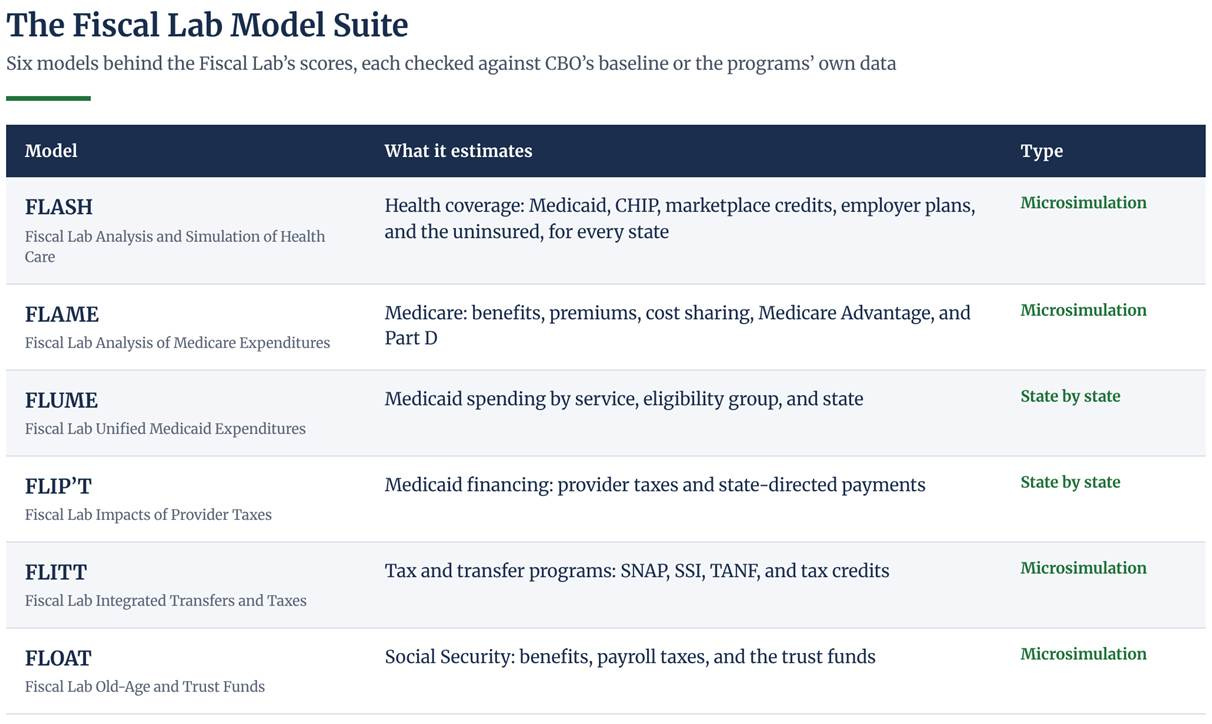
Four of the six are microsimulation models (FLASH, FLAME, FLITT, and FLOAT). Like CBO’s own health and tax models, they trace a policy’s effects person by person or household by household. The other two work state by state from Medicaid spending and financing data (FLUME and FLIP’T).
The suite’s first test was the Cost-of-Living Healthcare Working Group’s September 1 memo to Leader Hakeem Jeffries (D-NY), which lists 110 bills and proposals. As of early November, Congress.gov showed a CBO cost estimate for only two of them. Thanks to the new capabilities of our modeling suite, Fiscal Lab scored all 110.
Of those 110 scores, 57 add to federal deficits, 11 reduce them, and 42 have no significant budget effect. Each bill or provision is scored against current law over fiscal years 2027 to 2036. See the scores dashboard below in Figure 2.
Figure 2. Fiscal Lab’s dashboard of scores for the memo’s 110 bills and proposals
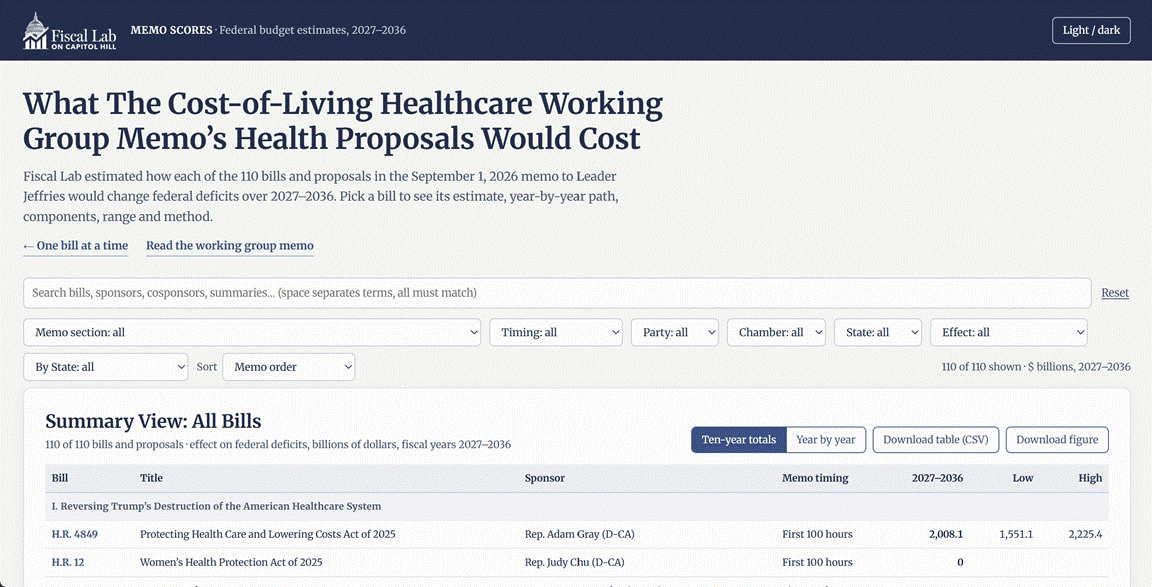
Each bill has its own page showing:
• A ten-year cost, with a low and a high case for the 69 bills where the evidence supports a range.
• Year-by-year effects on spending, revenues, interest, and debt, broken into the components that make up the total.
• Analysis covering what the bill does, what drives the estimate, what is uncertain, as well as all the sources.
• State-by-state results for 10 bills, with a map and a table covering every state.
Where CBO has published an estimate, it is shown beside the Lab’s for comparison.
A score is only useful if it can inform legislation as it moves through negotiations, markups, and floor schedules. A cost estimate that arrives after the key decisions are made can confirm or condemn a choice, but it can no longer inform one. Fiscal Lab’s goal is to provide vital analysis at the speed of decision making. The collection of 110 scores provides a poignant illustration of this. CBO has published estimates for two of the memo’s bills, and the Lab, running its own models in-house, was able to score all of them.
Speed matters most while a bill is still being written. With the release of this suite, an office can adjust a threshold, an effective date, or a matching rate and see what it does to cost and coverage before the text is final.
Although speed is essential, the quality of the analysis is equally so. To ensure this, every score shows its components, range, assumptions, and sources, so a drafter can see which provision drives the cost. When the data or the legislation changes, Fiscal Lab is able to update the score. And where a bill’s effects differ by state, members get state-by-state results, which CBO and JCT can rarely provide.
The suite of Fiscal Lab models will continue growing, with new models planned for release soon. The Lab is also in the process of forming a Scoring Methodology Advisory Panel to advise on how the estimates are made and where they can improve. If you would like to take part, contact Doug Branch at doug.branch@fiscallab.org.
Explore the dashboard here and read the full announcement here.
A Test for the 120th Congress
In his new op-ed for The Hill, Senior Fellow Doug Branch looks past the 2026 midterm elections to an issue that matters regardless of which party holds the majority: the deficit. Deficits add to the national debt and shape credit conditions, interest rates, the rate of inflation, and the cost of living.
Branch writes that no easy solution exists for the incoming congressional class. Raising tax rates has done little in practice to tame the growth in deficits. Despite large swings in tax rates over the last 60 years, federal revenue has stayed close to 17 percent of GDP, mostly within a band of 16 to 19 percent. Cutting spending has proven evidently unpopular under both parties. Since the Clinton era (1993–2000), spending has averaged 21 percent of GDP, about 4 percentage points more than the government consistently collects. Monetizing the debt means only further inflation, and voters have now decisively punished each party for inflation in successive elections.
Branch’s answer lies in a return to the Hamiltonian norm, in which Congress prioritizes protecting the full faith and credit of U.S. debt by taming the growth in deficits through restraint in spending and revenue policy. Democrats now hold 56 Senate seats and at least 258 House seats. If they can find a middle-ground path back to the norm with President Trump, one that both parties can accept as fair, Branch argues it could be transformational and could help Democrats hold their majority. If they fail, inflation will keep outrunning the subsidies Congress offers to offset it, and another electoral swing could follow. Winning the midterms is only the beginning. Now Democrats must deliver where their predecessors in both parties have failed. And the clock is ticking.
Read the full op-ed here.