

Fiscal Lab Notes is the official Substack page for the Fiscal Lab on Capitol Hill. You can check out all our work and analyses at fiscallab.org.
Actual Interest Rates vs. CBO Projections
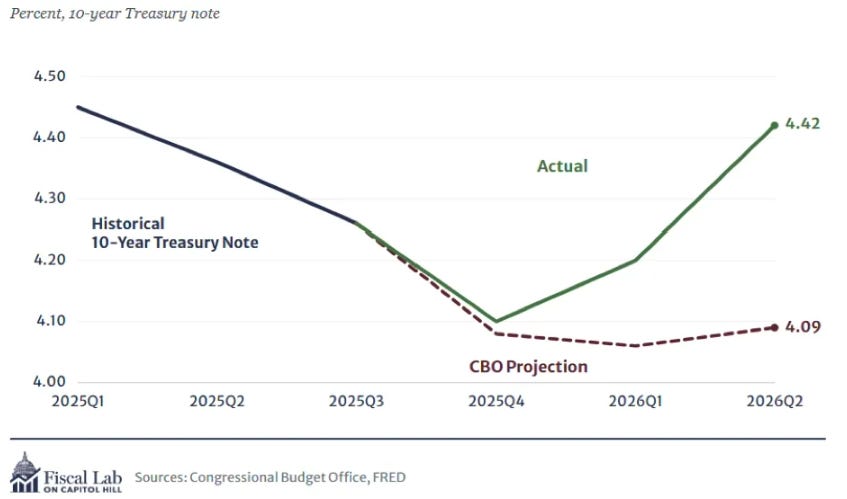
In a new Fiscal Lab brief, Matthew Dickerson observes that current interest rates are above the Congressional Budget Office’s (CBO) February 2026 projection. For example, as shown in Figure 1, the actual 10-year Treasury note yield was 4.20 percent in the first quarter of 2026 (14 basis points higher than in the baseline) and 4.42 percent in the second quarter (33 basis points higher than in the baseline).
Figure 1. 10-Year interest rates above CBO projections
Dickerson estimates that if the gap between actual and projected rates persists, federal outlays would increase by about $1.3 trillion over the next decade. With publicly held debt now larger than the US economy, he warns that high interest rates will worsen annual budget deficits.
The National Debt Is Already a Household Problem
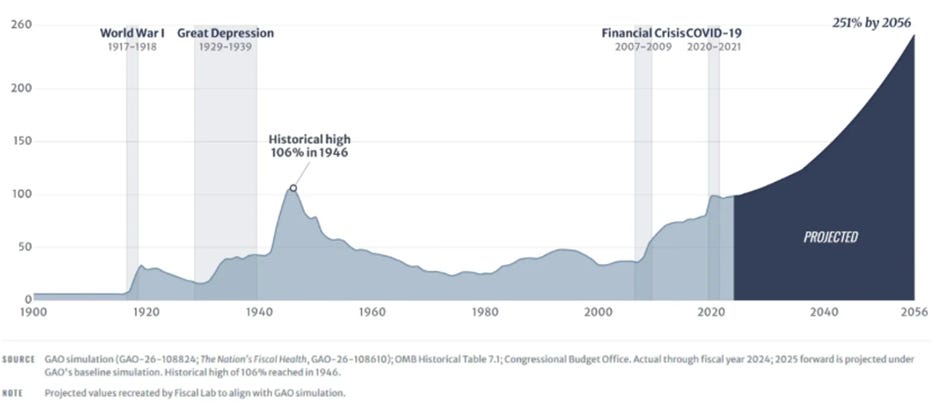
Joseph McCormack looks at a recent report from the US Government Accountability Office (GAO), which lays out the grim fiscal situation facing the country, in a new essay. As shown in Figure 2, not only is publicly held debt larger than 100 percent of GDP, it is expected to rise to a whopping 251 percent by 2056.
Figure 2. Publicly held debt as a percentage of gross domestic product
McCormack observes that the growth and trajectory of the debt have led to US credit downgrades and upward pressure on interest rates of not only US debt, but also mortgages, car loans, small business financing, and credit cards. Despite decades of warning signs, Congress has waited to confront budget deficits and to reform programs driving the deficit—Social Security and Medicare. McCormack points to potential reforms for Social Security, including benefit adjustments, means testing, and phased changes in eligibility. As he points out, “Gradual reforms, enacted today, may not be painless but are preferable to allowing the trust fund to fully deplete, which may force sudden reductions or rushed crisis legislation.”
Jaws as Budget Allegory
Writing in The Hill, Doug Branch argues that the 1975 classic Jaws is an analogy for the congressional budget process. After the first attack, the mayor of Amity Island claims the death was the result of a boating accident and refuses to close the local beach for fear that doing so would harm the local economy. After a second attack, the locals wrongly proclaim victory when they catch a tiger shark and ignore the warnings of consulting marine biologist Matt Hooper.
Like the mayor and locals who don’t want to recognize the real problem before them, Congress operates under a broken framework, the 1974 Budget Act, which fails to prevent chronic budget deficits. If we don’t move away from this flawed framework, the debt could swallow us whole.
A Puzzling Jobs Report
Job growth was frustratingly low in June as nonfarm payrolls rose by around 57,000, well below the 100,000 expected. In his latest jobs report, Bill Beach argues the report was full of surprises. Many observers thought the World Cup would produce more jobs in Leisure and Hospitality as soccer fans flocked to hotels, bars, and restaurants, but this sector fell by 61,000 jobs. On the other hand, Professional and Business Services, which is especially vulnerable to AI transformation and includes fields like consulting and computer systems design, grew significantly, adding 36,000 jobs.
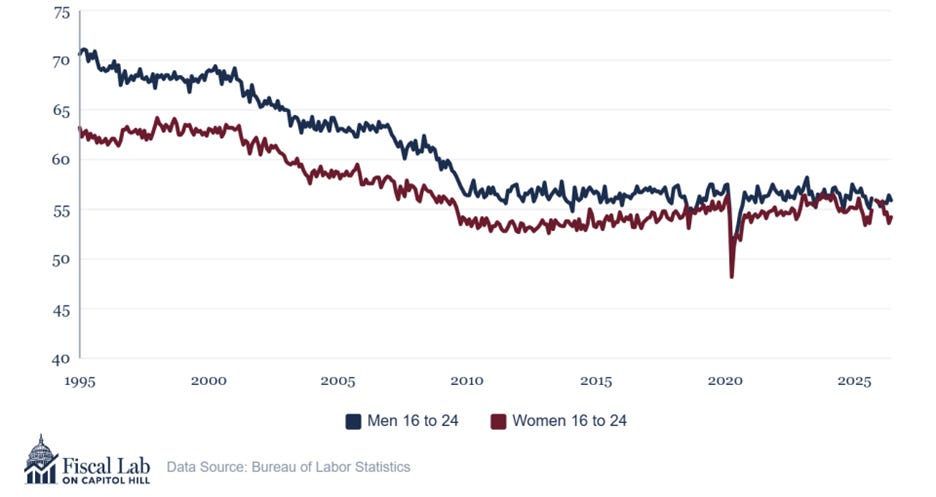
Although the unemployment rate fell from 4.3 percent in the previous month to 4.2 percent, the decline is likely due to a falling labor force participation rate. Beach also points to especially low participation from people ages 16 to 24. While this decline actually began many years ago and has been stable since around the Great Recession (as seen in Figure 3), it is troubling because it means many young Americans are choosing not to work.
Figure 3. Labor force participation rate, workers aged 16–24
Why the Fiscal Lab
Regular readers of this Substack will know why we created the Fiscal Lab: to educate Members of Congress and their staff on the fiscal crisis facing the United States and to provide analytical support for Members’ ideas to address this crisis.
In a new Fiscal Lab Update, Beach goes over these two reasons and how the Fiscal Lab fills a gap on Capitol Hill. The Fiscal Lab puts on seminars and holds briefings with House and Senate staff to teach them about the budget process, the major drivers of the national deficit and debt, and how poor fiscal policy both harms households and compromises the government’s ability to provide critical functions like defense, public infrastructure, and a social safety net.
Working with both sides of the political aisle, the Fiscal Lab provides scores and analysis that the CBO and Joint Committee on Taxation (JCT) do not have time to give. As Beach says, the Lab is “dedicated to the proposition that no good idea for addressing our fiscal crisis should die for lack of analytical support.” The Lab has also assisted Members’ offices in making clearer requests to the CBO and JCT, which has led to more productive conversations between those offices and the scoring agencies.
We’re proud of the difference we’re making on the Hill, but the debt and interest rate trends covered in this issue make clear we still have far more work ahead.