

The federal government has been roughly the same size as a percentage of the economy for 50 years. But how the government spends that money has changed significantly. Spending on the provision of public goods and services has shrunk, while transfer payments have grown to dominate the budget. Figure 1 shows just how much.
Figure 1- Federal Current Expenditures
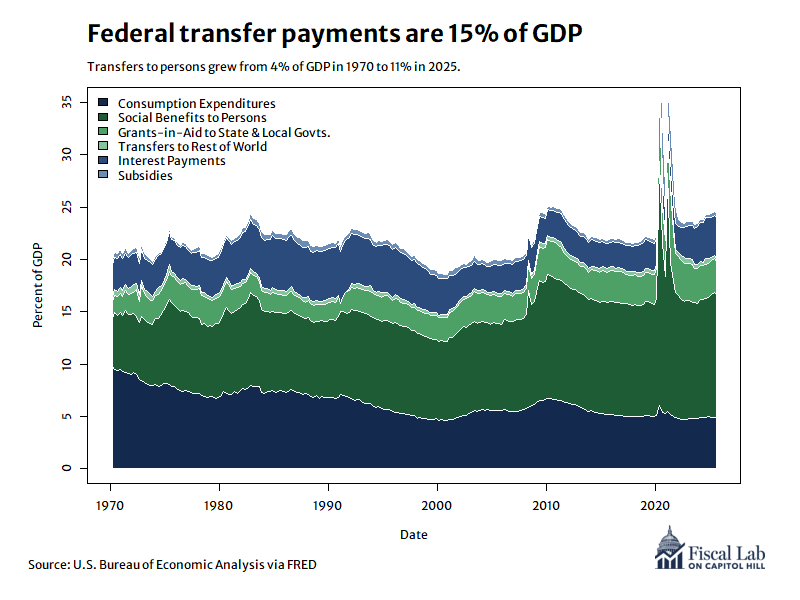
Instead of the typical budget categories, the chart shows federal spending as recorded in the national accounts. It further breaks current federal expenditures into four main components:
Consumption expenditures. Measures production and consumption of public goods by the government. Covers national defense, public safety, health, education, economic affairs, and other functions of government.
Transfer payments. Payments distributed by the government that do not produce a good or service, such as Social Security, Medicare, and Medicaid.
Interest payments. Payments that cover the cost of borrowing separately from the cost of production.
Subsidies. Payments to businesses or governments related to production that create a difference between the market value of a good and the value received by the producer.
Two trends from the graph are apparent:
The size of total current federal expenditures is roughly constant over time. The average total is 22 percent of GDP, and aside from spikes during the pandemic, the total stays within a few percentage points of the average.
Transfers grow over time. Spending on public goods and services has grown more slowly than GDP over time. Meanwhile, spending on transfers has grown to make up the majority of federal current expenditures. Much of the growth was driven by transfers to persons, which grew from 4 percent of GDP in 1970 to 15 percent of GDP in 2025.
Federal revenues have averaged about 18 percent of GDP over the same period. That’s more than sufficient to cover the cost of consumption expenditures, with some left over for moderate interest expenses and transfers. Reversing the growth in social benefits to persons back to 5 percent of GDP would be enough to bring current expenditures in line with current receipts and balance the federal budget.