

The Bureau of Labor Statistics (BLS) released a tantalizing jobs report on March 6 that may not have made the news it should have. The headline decline in net nonfarm jobs of 92,000 (that’s the fifth negative month in the past year) gained some attention. Otherwise, BLS reported little change in the all-important unemployment rates and levels of work engagement across demographic groups. I titled my report, which was published by the Economic Policy Innovation Center (EPIC), as “Flat Job Gains.”
The headline statistics, however, were not, in my opinion, the tantalizing part of BLS’s employment situation summary. Rather, BLS announced new “population controls” for calendar year 2026 based on the Census Bureau restatement of the US population that Census announced in early January. BLS uses population estimates or controls from Census to “plus up” their survey results to national totals.
Due to deficiencies in the Decennial Census of 2020, principally age grouping and other distortions to the composition of the population, Census had employed a methodology that blended population trends to smooth through the issues in 2020. That ended in 2025 when Census implemented new techniques to estimate component totals for 2020 onwards, and these improved estimation approaches significantly changed estimates of the population components. In addition, Census developed better estimates of immigration that also contributed to total and compositional changes.
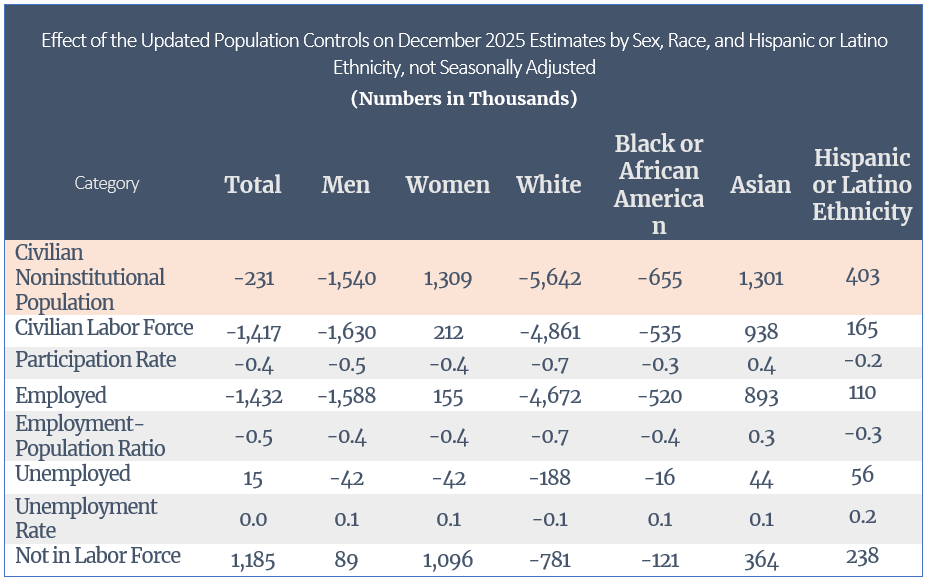
BLS incorporated these new population controls or estimates, which are displayed in this table that comes from my EPIC jobs report. Census and BLS made the single biggest change in the population of whites aged 16 and above. The white population count fell by 5,642,000, and this reduction primarily fell in prime age whites 24 to 55 years of age, which saw a reduction of particularly 3,966,000. Some analysts suspect that most of this white population loss was recoded to the category of “more than one race.” There are fewer males and more females in the population. There also are fewer African Americans and more Asians and Hispanics. The new population controls resulted in fewer people working (total employment fell by 1,432,000) and more people counted as not in the labor force (neither working or looking for work: +1,185,000).
These new population estimates could have significant effects on the distribution of federal funding by state and region and through programs designed to address sex and racial policy goals. While fairly technical, this is the type of detailed change that moves Washington’s goal posts.