

Fiscal Lab Notes is the official newsletter for the Fiscal Lab on Capitol Hill. You can check out all our work and analyses at fiscallab.org.
The Fiscal Lab Expands
The Lab is thrilled to announce Drew Gonshorowski has joined as a Senior Fellow in Means-Tested Programs. Gonshorowski recently served as the Director for Medicaid and Long-Term Care for the State of Nebraska. Previously, he was a Senior Research Fellow with the Paragon Health Institute, where his work focused on Medicaid policy and budgetary analysis. He began his public policy career at The Heritage Foundation nearly 15 years ago, where he was a research fellow with the Center for Data Analysis.

Drew Gonshorowski joins the Fiscal Lab.
In Nebraska, Gonshorowski’s work focused on implementation of federal policy, prevention of fraud, waste, and abuse in Medicaid, and modernization and systems improvements for Medicaid programs. He led his program through a first-in-the-nation implementation of H.R. 1’s work requirements, designing end-to-end processes and solutions in state-owned systems. He also led his program in building a comprehensive set of policies, guardrails, and reimbursement structures to address issues around applied behavior analysis services, serving as a national model for program integrity reforms.
Gonshorowski joins the Fiscal Lab to apply his expertise in building reforms that ensure fiscal sustainability in means-tested programs. While his most recent work centered heavily on Medicaid, he will also work across all means-tested programs, including Medicare, Social Security, the Supplemental Nutrition Assistance Program (SNAP), and Temporary Assistance for Needy Families (TANF).
As someone who has built models to score federal legislation and then went on to run a state Medicaid program, Gonshorowski brings an extremely rare skill set to Capitol Hill. He is available to provide technical assistance to congressional offices as they build reform proposals regarding means-tested programs, and will bring his expertise to the Lab’s scoring services.
CR Seminar
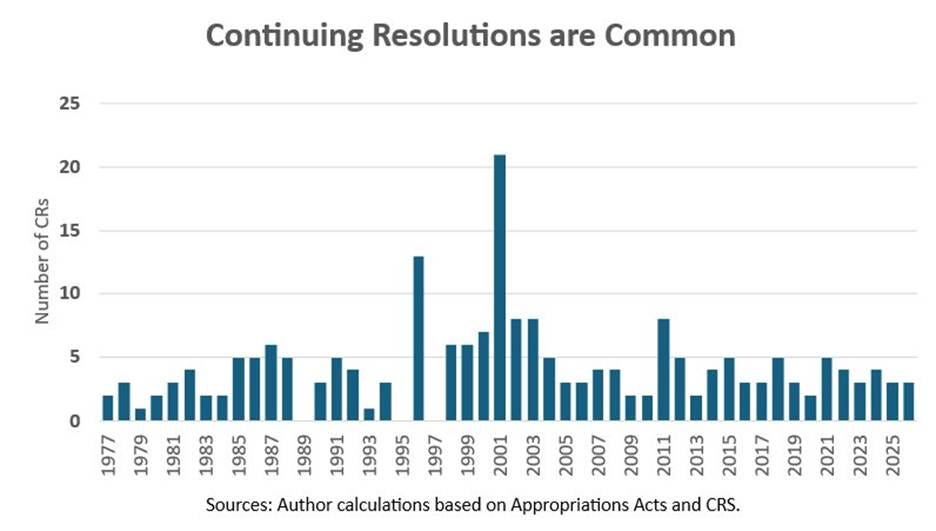
Congress’s fiscal year ends at the end of September. Although Congress is supposed to pass 12 appropriations bills by October 1 to fund the discretionary side of the federal budget for the new fiscal year, it rarely follows the proper process. Instead, Congress frequently resorts to continuing resolutions (CRs), temporary measures that extend previously enacted levels of spending. Failure to fund the government through appropriations, CRs, or some other mechanism results in a government shutdown.
Although CRs may seem relatively straightforward, they can get complicated. To help congressional staffers better understand the ins and outs of CRs, the Fiscal Lab hosted a seminar, “Understanding Continuing Resolutions,” led by Senior Fellow Matthew Dickerson.
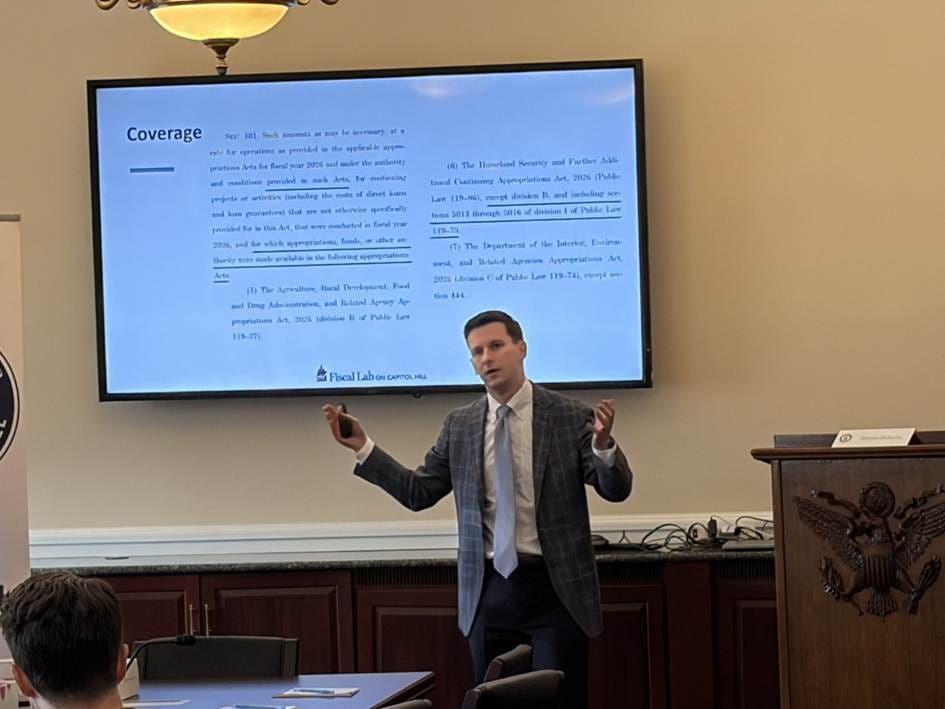
The Fiscal Lab’s Matthew Dickerson
Dickerson started with the history of CRs, noting that Congress has passed all 12 appropriations bills by the October 1 deadline only a handful of times since 1977—CRs, not on-time funding, are the normal state of affairs. And although people tend to think of a CR as simply extending last year’s funding at the exact same level, Congress can amend the standard rate-of-operations language to whatever level it wants—and has.
Even a CR that changes nothing on its face can still score differently from the prior year, because of scoring conventions like changes in mandatory programs (CHIMPs) and rescissions. CHIMPs let appropriators count savings from a mandatory program toward the discretionary total, freeing up room to spend elsewhere. Rescissions cancel funding Congress had already enacted in a prior law, which lowers the baseline a CR is measured against. Neither shows up as a change to the CR’s rate-of-operations language, but both can move the final number away from what “flat funding” would suggest.
Dickerson also discussed a “checklist” staffers should consider when reading a CR, how to review whether programs Members care about are included in a CR, and how a CR both expands and limits presidential discretion in using appropriated funds.
The House passed a Senate-approved CR on September 1, which President Trump signed the following day. This CR extends funding through December 11, so while a government shutdown has been averted for now, Congress will face another budget battle prior to the holidays. Therefore, knowing how CRs work is still especially relevant.
The Fiscal Lab has also published a video playlist on CRs to go along with the seminar.