

Fiscal Lab Notes is the official Substack page for the Fiscal Lab on Capitol Hill. You can check out all our work and analyses at fiscallab.org.
This week we cover a jobs report with some mixed signals, Bill Beach’s case at AEI for Congress to lock in regulatory reform, and a new brief from Joseph McCormack on how Washington’s fiscal delays are already reaching household budgets.
Mixed Signals in the September Jobs Report
In his latest Fiscal Lab Jobs Report, former Bureau of Labor Statistics (BLS) Commissioner, Bill Beach, offers his insight on the September 2026 Employment Situation. Nonfarm payrolls came in well below economists’ expectations of 84,000, rising by just 29,000. BLS also revised the two prior months down by a combined 60,000. July fell from 21,000 to −10,000, the first negative print since February, and August dropped from 162,000 to 133,000. See monthly job growth below in Figure 1.
Figure 1. Monthly change in total nonfarm payroll employment (in thousands)
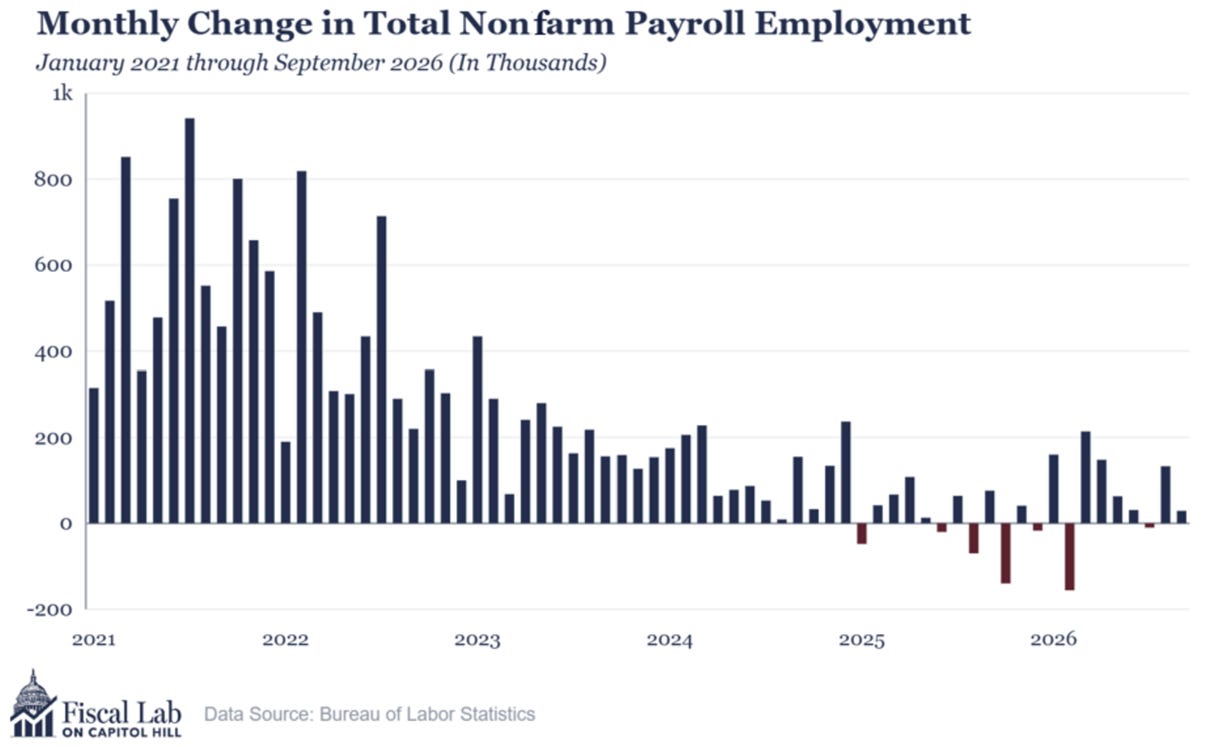
Beach points out though that the topline number hides more encouraging signals from the private sector. Private employers added 46,000 jobs in September, up from 28,000 in July. The decline was driven by government, which shed 17,000 jobs, mostly in local government, and is now down 216,000 over the past year. Manufacturing has been a bright spot this year, adding 72,000 jobs since January, all of it in durable goods. Similarly, construction is up 109,000 over the year, with specialty trade contractors tied to data center construction, contributing 84,700. Finally, healthcare anchored private-sector job growth with 371,800 new jobs, making up two-thirds of all private-sector growth since September 2025.
Nonetheless, there are gathering headwinds in financial services, information services, and computer design and management services, which together lost 259,200 jobs over the year. Beach expects continued restructuring as AI assumes tasks workers used to do. The unemployment rate rose to 4.2 percent, but it is important to point out that the actual increase was only 0.03 percentage points, just enough to round up, and it was not statistically significant. Labor force participation rose from 61.6 to 61.8 percent.
Beach’s takeaway from the September report is that the economy is still on a moderate growth path, and one soft month doesn’t change that. “That’s why it is crucial for policymakers and investors to have a longer time horizon,” he writes.
Beach at AEI: Can Congress Lead Regulatory Reform?
On September 30, Beach joined a panel at the American Enterprise Institute on whether Congress can lock in regulatory reform. AEI’s Jeffrey A. Rosen moderated the panel. Other panelists included Anthony P. Campau of Clark Hill Public Strategies and Daniel M. Flores, senior counsel on the House Committee on Oversight and Government Reform.
The executive branch has limited its own regulatory processes through tools like regulatory budgets, and the Supreme Court has ended Chevron deference. Congress, however, has not enacted regulatory reform legislation in decades. Reform bills passed the House in the 113th, 114th, and 115th Congresses, but none reached the president’s desk.
Drawing from his time as BLS commissioner, Beach argued that codifying reforms such as the REG Budgeting Act (H.R. 3279) could produce significant economic benefits. The bill would require the Office of Management and Budget to set annual government-wide and agency-level caps on new regulatory costs. A rule that pushes an agency past its cap generally could not take effect that year without congressional approval. The cost of regulation weighs on households and businesses much as spending does, and a clear budget for those costs would give Congress a way to identify these costs and limit them.
The Rising Cost of Delay
In a new brief, Joseph McCormack looks at how Washington’s fiscal failures are already weighing on household budgets. Persistent deficits add to inflationary pressure and push up Treasury yields, which raises borrowing costs for everyone. McCormack highlights that 30-year mortgage rates have historically run about 150 basis points above the 10-year Treasury yield. Recently, though, this spread has been closer to 200. For a family buying a house this can mean a much higher monthly payment.
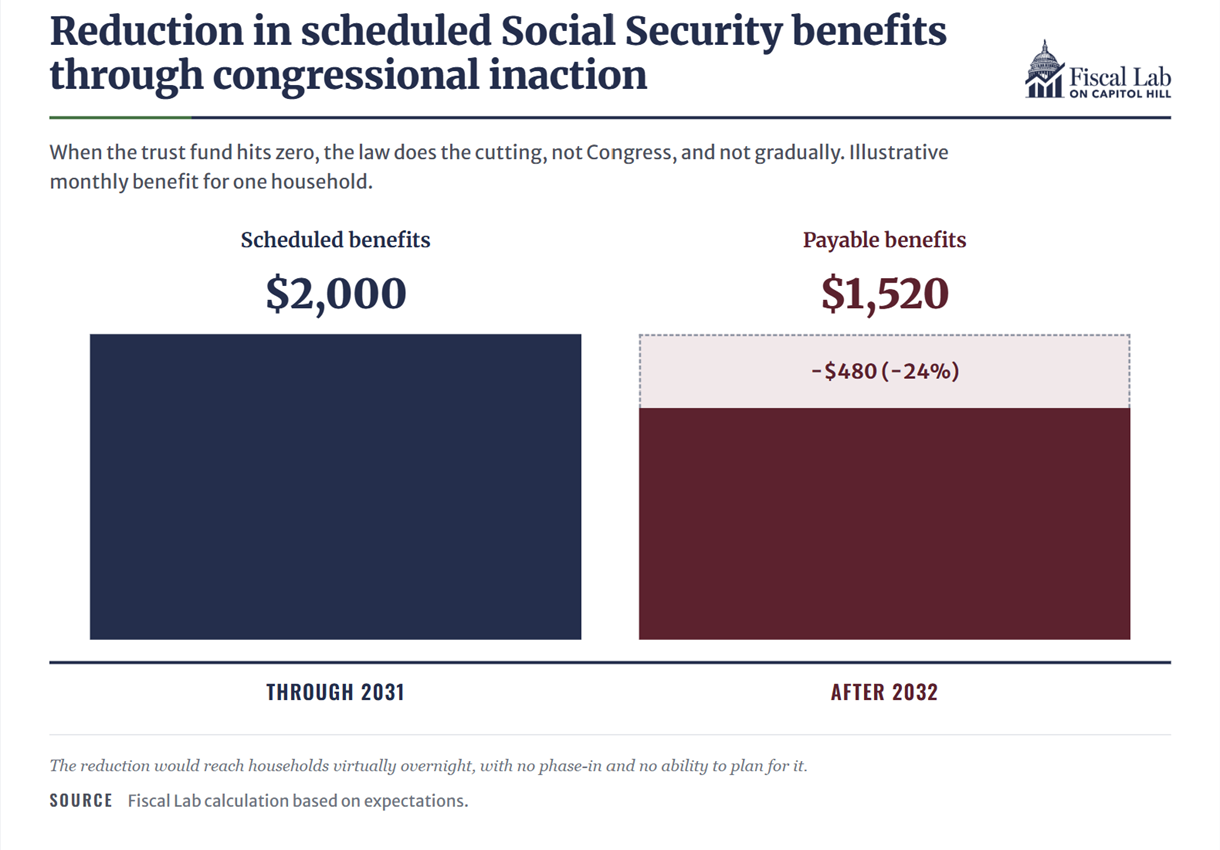
Then there are the benefit programs that many households have come to depend on. Under current projections, the Old-Age and Survivors Insurance trust fund will be exhausted in late 2032. At that point payable benefits are automatically cut by 24 percent, reducing a $2,000 monthly benefit to roughly $1,520, as shown in Figure 2. And this is only the beginning with Medicare’s Hospital Insurance trust fund facing depletion around 2040.
Figure 2. Reduction in scheduled Social Security benefits through congressional inaction
McCormack also points out that annual budget fights consistently focus on the wrong part of the budget. Mandatory programs and net interest made up about three-quarters of federal outlays, but shutdown fights focus on the remaining quarter of discretionary spending. Meanwhile, interest costs keep compounding. Higher interest costs raise the deficit, larger deficits require more borrowing, and more borrowing means more interest. And so, the cycle continues.
The options that remain to Congress for reducing the debt burden inevitably require painful choices. McCormack argues the worst option is delay. Unfortunately, this is the option Congress has most consistently chosen. Acting now would allow reforms to be phased in, with protections for people nearing retirement and lower-income households. Waiting lets trust-fund depletion or market pressure decide who bears the cost. “The difference is not between pain and no pain,” he writes. “It is between limiting the pain through planning and allowing circumstances to impose it abruptly.”
If Congress wants to protect household budgets, the time to act is before the choice is taken out of its hands.