

Fiscal Lab Notes is the official Substack page for the Fiscal Lab on Capitol Hill. You can check out all our work and analyses at fiscallab.org.
This week we review the October jobs report that beat expectations by more than 100,000 jobs, Bill Beach’s explanation for why voters feel worse off anyway, and Matthew Dickerson’s updated calendar of fiscal deadlines.
Why a Strong Jobs Report Still Feels Weak
In his latest Fiscal Lab Jobs Report, Fiscal Lab Executive Director and former Bureau of Labor Statistics (BLS) Commissioner Bill Beach analyzes the October 2026 Employment Situation. Arriving only days after an election that turned on voters’ unease about the economy, this report tells a different story than the public mood might indicate. Economists expected about 60,000 new jobs. BLS reported 165,000, with 159,000 of them in the private sector. BLS also revised August up by 53,000 and September up by 31,000. See monthly job growth below in Figure 1.
Figure 1. Monthly change in total nonfarm payroll employment (in thousands)
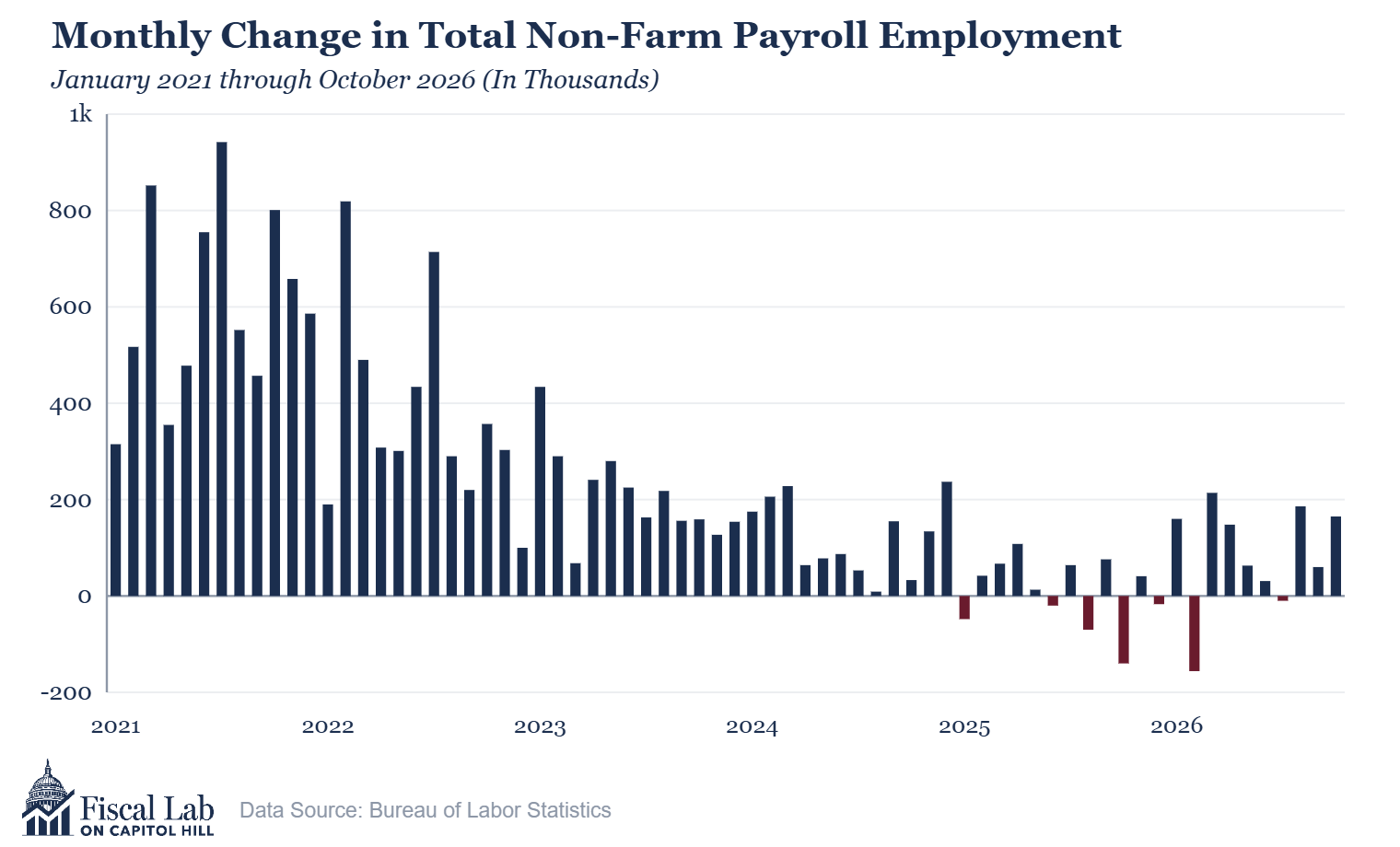
The gains were broad. Professional and business services added 70,000 jobs, health care and social assistance added 55,100, durable goods manufacturing added 25,000, and transportation and warehousing added 24,800.
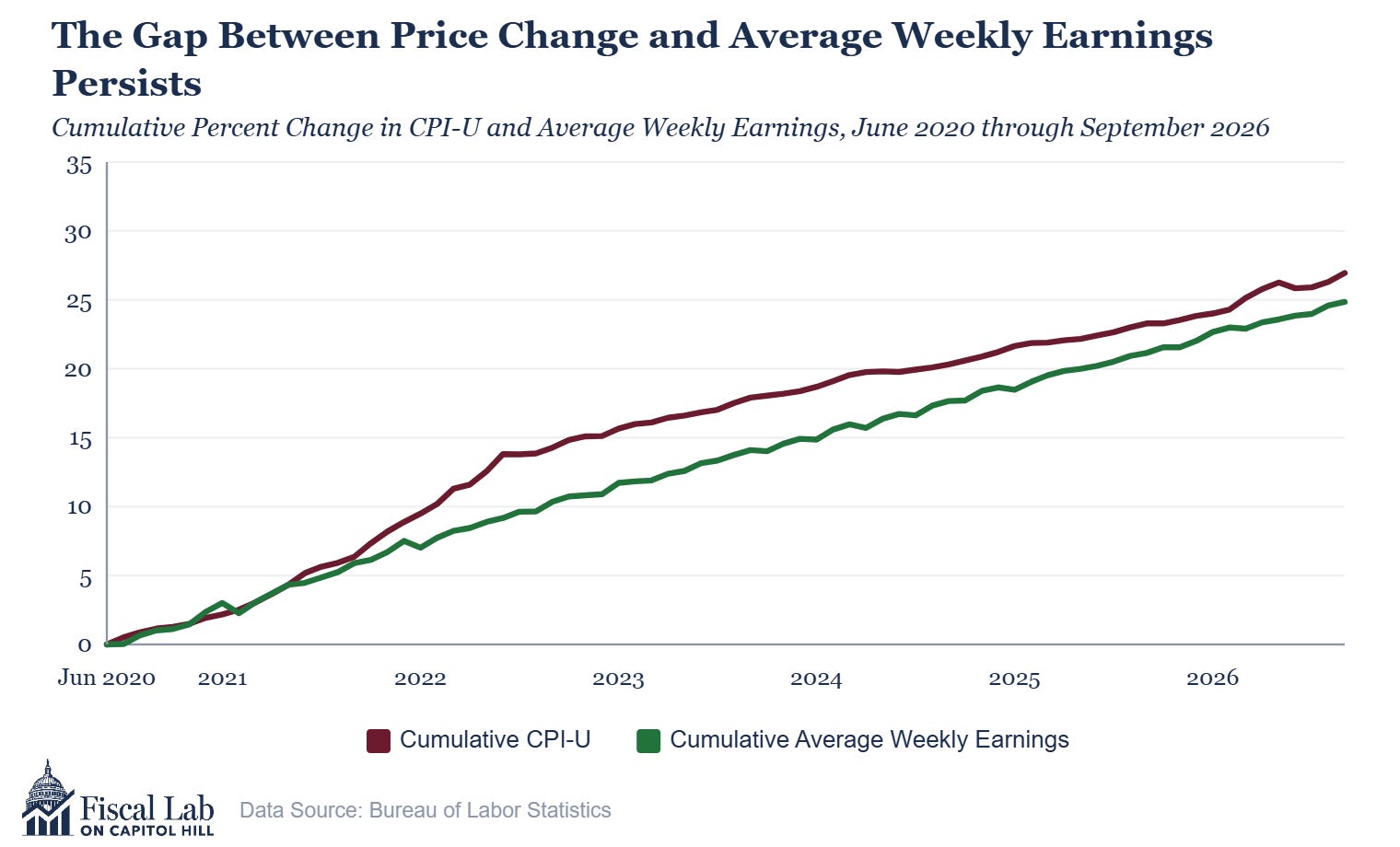
So why are voters so negative? Beach doesn’t think they are unaware or misinformed. “Ascribing ignorance to voters is never advisable,” he writes. He highlights that the answer to the dissonance may be in purchasing power. Since 2021, prices have risen faster than average weekly earnings. The two are now growing at about the same pace, with the Consumer Price Index up 3.7 percent and earnings up 3.76 percent. But keeping even with inflation today does nothing to close the gap that opened over the past four years, as shown in Figure 2. Until earnings outpace prices for a sustained period of time, households will rightly conclude that their standard of living has slipped.
Figure 2. Cumulative change in the CPI and average weekly earnings since June 2020
Beach points out that there are reasons to think improvements in the household standard of living could be coming. BLS announced on November 5 that nonfarm business labor productivity rose 3.6 percent in the third quarter. Rising productivity puts upward pressure on wages. Manufacturing offers a clear example. The sector added 19,000 jobs in October and is up 101,000 jobs since December 2025. In durable goods, productivity is growing at a 1.9 percent annual rate and compensation at 5 percent.
It is also encouraging to see that the unemployment rate slipped to 4.1 percent, though the change was not statistically significant. Perhaps more interesting is the fact that labor force participation rose to 61.9 percent. The one-month move was small, but the three-month gain of half a point is statistically significant, and, most importantly, it came from more people working rather than more people looking for jobs.
Even small changes in the participation rate reflect significant changes in the labor force. With 275.7 million Americans aged 16 and older, each percentage point is about 2.76 million workers and job seekers. Beach estimates that a return to the pre-pandemic participation rate of 63.3 percent, last seen in February 2020, would bring another 3.9 million people into the labor force. That is more than half of the 7.1 million currently unemployed.
Beach concludes with a message for the incoming class of policymakers headed to Washington and the state capitols. Today’s strength does not guarantee tomorrow’s, and their job is to avoid the policies that would stunt or prevent growth.
Read the full report here.
Upcoming Fiscal Policy Deadlines
Policymakers have a full calendar of upcoming deadlines. Thankfully, Senior Fellow Matthew Dickerson has updated his primer, Upcoming Fiscal Policy Inflection Points, 2026 through 2034, which puts every scheduled statutory expiration, authorization lapse, and program change across the federal budget on a single schedule. In this November update, Dickerson includes this fall’s continuing resolution and adds the Fiscal Lab’s own debt limit projections.
December 11. The first inflection point is less than one month out. The fiscal year 2027 continuing resolution expires on December 11, and a long list of authorities expires with it: surface transportation, the National Flood Insurance Program, certain veterans’ health care extensions, the Defense Production Act, and several others.
December 31. The rapidly approaching year-end will bring with it a second cluster of deadlines. Temporary Assistance for Needy Families funding, the 2.5 percent Medicare physician payment increase, and the health extenders all expire, including funding for community health centers. The Export-Import Bank loses its authority to conduct new business, and construction must begin by that date to qualify for the CHIPS and Science Act investment credit.
January 1. The new Congress will begin with policy changes already in motion. When the new year begins, the suspension of farm subsidy “permanent law” ends, starting with dairy. The One Big Beautiful Bill Act Medicaid provisions also take effect, including community engagement requirements for able-bodied adults and six-month eligibility redeterminations for expansion adults.
Other dates that will shape the policy landscape of the year ahead:
March: The Fiscal Lab projects that the $41.1 trillion debt limit will be reached.
September 30: Food and Drug Administration drug and medical device user fee authorities expire, along with the Medicaid extenders and the delay of disproportionate share hospital reductions.
October 1: States begin sharing in food stamp benefit costs based on their improper payment rates, and the Medicaid provider-tax safe harbor phases down to 5.5 percent in expansion states.
Fall: The Fiscal Lab projects that the debt limit X-date will arrive.
December 31: Temporary Medicare telehealth flexibilities expire, and wind and solar projects that began construction after July 4, 2026, must enter service to qualify for tax credits.
2028 and 2029. Federal Aviation Administration authorization and most Highway Trust Fund motor-fuel taxes expire on September 30, 2028, the same year the Congressional Budget Office projects the trust fund’s reserves will be exhausted. The OBBB deductions for tips, overtime, car-loan interest, and seniors expire on December 31, 2028. A year later, the higher state and local tax deduction cap expires, returning to $10,000 in 2030. OBBB defense and border security funding runs out on September 30, 2029.
2032 and 2033. The calendar closes with the two dates Congress has had the longest to prepare for. Social Security’s Old-Age and Survivors Insurance reserves are projected to be depleted in the fourth quarter of 2032, when the Trustees project only 78 percent of scheduled benefits will be payable. Medicare’s Hospital Insurance reserves follow in the second quarter of 2033, with 89 percent of scheduled expenditures payable.
Dickerson’s schedule offers a useful resource to Hill staff, but it also highlights a crucial point for the incoming congressional class. The Social Security date now falls inside the six-year terms of the recently elected senators, and, unlike their predecessors, they will not have the luxury of kicking the can down the fiscal road.
See the full calendar here.