

Fiscal Lab Notes is the official Substack page for the Fiscal Lab on Capitol Hill. You can check out all our work and analyses at fiscallab.org.
Bias in the Baseline
In case you missed his post earlier this week, Parker Sheppard observes that the Congressional Budget Office (CBO) baseline contains assumptions that obscure the true level of government spending. Although the baseline is generally thought of as a projection assuming no changes to current law, there are exceptions. For example, certain mandatory spending programs, including SNAP, TANF, and CHIP, are assumed to continue beyond their expiration dates. Discretionary spending is also assumed to keep pace with inflation. Sheppard explains that:
The baseline rules force lawmakers to recognize the maximum total cost of a policy when initially putting it in place. But the outcome has been the opposite of the intent. By treating continuation as the default, the baseline rules make extending certain programs appear costless because they are not included in CBO’s score.
He points out that the “Cost Estimate Clarity Act,” recently reintroduced by Rep. Ben Cline and Sen. Roger Marshall, would require the CBO to disclose the gap between the statutory baseline, which includes these hidden exceptions, and an actual policy baseline. Lawmakers would then have a clearer sense of how much legislation actually costs.
Q1 GDP Data
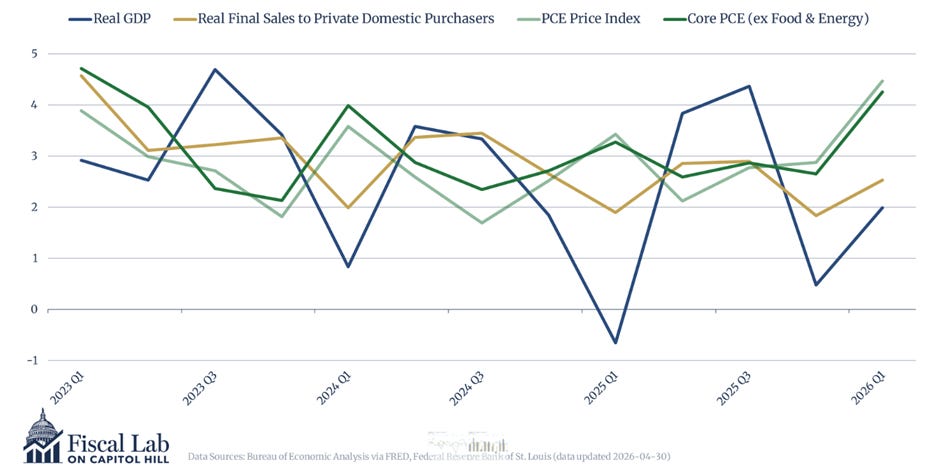
On Thursday, the Bureau of Economic Analysis released the advance estimate of GDP data for the first quarter of 2026. Real GDP grew at an annual rate of 2.0 percent—slightly below the 2.2 percent consensus forecast—but well above the previous quarter’s anemic 0.5 percent. Joseph McCormack observes that much of the growth came from business investment, reflecting continued growth in the AI industry.
However, the news is not all rosy. Consumer spending slowed from the previous quarter, while inflation ticked up noticeably. The Personal Consumption Expenditure Price Index, the Federal Reserve’s preferred inflation measure, rose 4.5 percent, well above the Fed’s 2 percent target. Although the recent war with Iran contributed substantially to energy prices, even core inflation, which strips out energy and food prices, rose 4.3 percent.
Figure 1 shows real GDP growth in dark blue, real final sales to private domestic purchasers (a measure of “core GDP,” which only includes consumption and noninventory investment) in gold, overall or headline PCE inflation in light green, and core inflation in dark green. While the pickup in real GDP and real final sales to private domestic purchasers are encouraging, the high inflation numbers could spell trouble for consumers as well as the broader economy.
Figure 1. Economic output and inflation, Q1:2023–Q1:2026
Source: The Federal Reserve Bank of St. Louis
Horan on the Let People Prosper Show
This week, I had the honor of appearing on economist Vance Ginn’s Let People Prosper Show. Vance and I spoke mainly on the United States’ grim fiscal outlook. Today’s large budget deficits are not due to one-time events such as war or recession. Rather, they are caused by increased mandatory spending, which, unless reformed, will contribute to even larger future budget deficits. Those large deficits, in turn, are contributing to higher interest payments, further worsening the federal debt.
We also discussed why tariffs are unlikely to be a great policy reform in reducing the deficit even if they generate some revenue in the short term. True reform will consist of a more disciplined approach to federal spending and policies that enhance economic growth.