Economic Growth Rates and the Deficit
When the Fiscal Lab launched in September 2025, Parker Sheppard and William Beach asked the question: “How much would GDP [gross domestic product] have to grow to eliminate the deficit without raising taxes or cutting spending?”
One year later, the question is still timely. In August, when commenting on the federal debt reaching a new high, Treasury Secretary Scott Bessent said, “there’s nothing magic about the $40 trillion number. And we can grow our way out of that.”
Sheppard and Beach have updated their results from one year ago. While higher economic growth does lead to greater revenue and therefore reduces the budget deficit, growth by itself is highly unlikely to balance the budget.
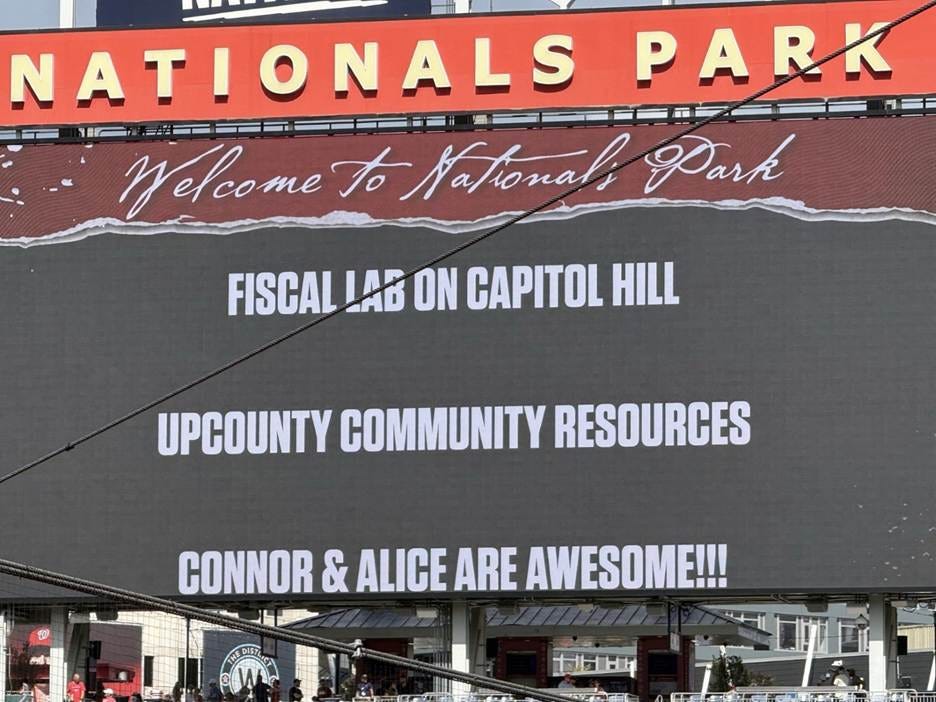
They find that if Congress makes no changes to spending or taxes, real GDP would have to average 4.67 percent, up from 4.31 percent in the previous estimate, in order to eliminate the deficit in 10 years. The United States has only experienced such high growth in about 25 percent of the quarters since 1947. Put differently, GDP would need to grow a substantial 2.88 percentage points per year faster than the baseline of the Congressional Budget Office (CBO).
The authors also consider two other scenarios. First, Congress sharply reduces mandatory spending by 20 percent in the first year of the budget window and then allows it to grow at the same rate as in the baseline. Second, Congress reduces mandatory spending by 2 percent in the first year and then keeps its growth 2 percent slower than in the baseline. As shown in Table 1, these scenarios require average real GDP growth of 3.02 and 3.41 percent, respectively, to balance the budget.
Table 1. Real GDP growth needed to balance the budget in FY2036 (average annual percent growth, 2027–2036). Source: Authors’ calculations based on CBO’s February 2026 baseline.
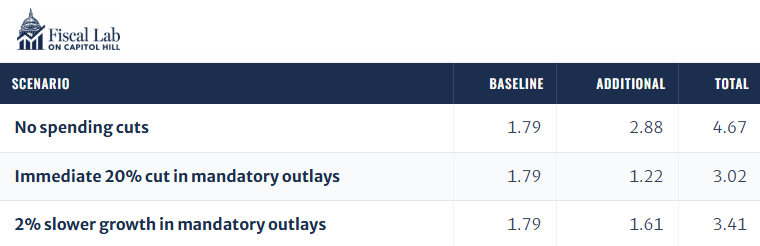
Sheppard and Beach also consider a less ambitious and more realistic goal: achieving primary balance in which revenue covers all noninterest spending. As seen in Table 2, the real GDP growth rates needed to achieve primary balance under the same scenarios are closer to the CBO baseline.
Table 2. Real GDP growth needed to reach primary balance in FY2036 (average annual percent growth, 2027–2036). Source: Authors’ calculations based on CBO’s February 2026 baseline.
Gonshorowski on States and Medicaid Fraud and Program Integrity
On September 17, Drew Gonshorowski, the Fiscal Lab’s Senior Fellow in Means-Tested Programs, participated in a live podcast discussion on fraud and improper payments in Medicaid, co-hosted by Tradeoffs, a nonprofit news organization focused on healthcare, and the University of Pennsylvania’s Leonard Davis Institute of Health Economics. Gonshorowski, the former director of Medicaid and Long-Term Care for the State of Nebraska, was joined by Amir Bassiri, the director of Medicaid for the State of New York, and Kevin Lownds, the division chief of the Medicaid Fraud Division in the Massachusetts Attorney General’s Office.
All the participants agreed that fraud and waste in Medicaid are real and should be addressed. Gonshorowski, Bassiri, and Lownds each gave examples of problems they had dealt with, ranging from egregious cases of stolen patient IDs used to bill for services never provided to less sensational issues such as failure to sign documentation. They also discussed the Trump administration’s recent efforts to combat fraud as well as concerns some have that such efforts could disrupt legitimate patient care.
When asked if he was worried about people being hurt by excessive anti-fraud efforts, Gonshorowski observed that people are also hurt from inaction. “If you aren’t protecting your programs for the people that need them, and you’re also not policing whether or not they enter into services that actively harm them, you create a massive risk for your program.”
The Fiscal Lab Celebrates One Year at Nats Park
The Fiscal Lab launched on September 15, 2025. Since then, we have scored hundreds of bills for Members of both parties on issues including but not limited to taxation, means-tested programs, healthcare, infrastructure, drug policy, and housing. We have held dozens of private briefings with committee and Member staff as well as educational seminars on budget policy and the importance of fiscal discipline. The Fiscal Lab also educates through its YouTube channel, which includes short-form videos giving brief explanations of different budget concepts as well as longer-form conversations on economic and fiscal policy.
In July, the Fiscal Lab launched the Center for Strategic Fiscal Reform (CSFR), a regular meeting series to discuss pressing fiscal matters. CSFR is a successor to the Center for Strategic Tax Reform, headed by the late Ernie Christian, a prominent and tireless tax reformer. CSFR is designed to be a place for top minds to analyze the latest research and candidly debate the vast fiscal challenges that lie ahead.
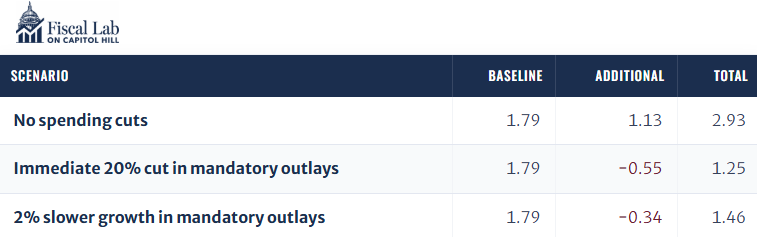
While there is no shortage of work ahead of us, we also like to enjoy ourselves! To celebrate our anniversary, the Fiscal Lab team, along with family and friends, went to Nationals Park to see the Nats make an exciting comeback against the Los Angeles Angels on September 13. Fun was had by all. We also received a warm digital welcome!