


Fiscal Lab Notes is the official Substack page for the Fiscal Lab on Capitol Hill. You can check out all our work and analyses at fiscallab.org.
Everything this week seems to come back to the price of borrowing. The national debt crossed $40 trillion, the Federal Reserve’s new chairman is moving in ways that could make servicing it more expensive, and Congress still scores legislation without counting the interest expense it generates.
The Road to $40 Trillion in Debt
This week marked a dubious threshold in our nation’s fiscal history, as gross federal debt exceeded $40 trillion for the first time in our Republic’s history. Since 1982, federal debt has grown from $1 trillion to $10 trillion in 2008, and it has quadrupled that staggering sum to our present level in just the last 18 years.
Figure 1. The road to $40 trillion in debt

These are big numbers, and we often see them exploited to score political points, without any real intent to make the difficult decisions that would improve our nation’s worsening fiscal condition. The Fiscal Lab remains committed to avoiding politics and helping Members of Congress and staff understand what the economic realities mean for our nation’s fiscal health, both at the national level and for everyday Americans.
The good news is that congressional staff are interested in reflecting upon and understanding the situation posed by our growing debt. Even during the August congressional recess, which is one of the few times that staff are able to take leave, the Fiscal Lab hosted a very successful and informative video conference with nearly two dozen influential staff from congressional Member, committee, and leadership offices.
The Fiscal Lab team addressed key elements such as borrowing costs, assets and inflation, the convenience yield, how debt affects the labor market, and the need to return to the Hamiltonian norm. Congressional staff were receptive to the considerations presented, and there was robust Q&A regarding economic growth, reforming means-tested programs, and elements related to the market for Treasuries. Equipping congressional staff with a greater understanding of the real-world effects and options for navigating a course back from the brink of fiscal crisis is among the most rewarding aspects of our work at the Fiscal Lab.
What Can Congress Do to Bring Down Inflation?
For the first time in eight years, the Federal Reserve has a new chairman, and bond markets have noticed. In a new video, Parker Sheppard explains what Chairman Kevin Warsh is doing and why the Fed cannot bring inflation down without help from Congress.
Warsh has outlined three key changes to try to curb inflation: a firm commitment to the 2 percent inflation target after years of flexible targeting, a narrower remit on the view that Fed programs addressing fiscal and social policy invite political interference, and a smaller balance sheet. Sheppard also highlights the direct budgetary implications of the Fed’s actions. With debt held by the public approaching 100 percent of gross domestic product (GDP), rates only a third of a percentage point above the Congressional Budget Office’s (CBO) projections, roughly where they are running this year, would add $1.3 trillion to deficits over a decade.
Congress delegated monetary policy but kept the borrowing power. Someone must set the price level, and someone has to balance the budget. Sheppard points out that if we run large enough deficits and the roles invert so that the deficit sets the inflation rate and the Fed prints to close the gap, we find ourselves trapped in a state of fiscal dominance. Perhaps the worst possible outcome is if Congress continues to create large deficits and the Fed refuses to accommodate them, both end up fighting inflation, and nobody balances the budget.
He concludes with two practical steps Congress can take. First, it should commit to a credible deficit target, such as 3 percent of GDP, a level it has achieved repeatedly in the postwar era. Second, when CBO scores legislation, it should include the associated interest cost of deficit spending.
Washington Math and the True Cost of Federal Spending
Parker Sheppard’s second practical step for Congress is the subject of a new essay by Joseph McCormack and Michael Schultz. Because scoring convention excludes the interest expense of a deficit-financed bill, Congress is left to debate the price of legislation without counting the price of borrowing to pay for it. To borrow a term popularized by the Economic Policy Innovation Center (EPIC), this is Washington math.
McCormack and Schultz illustrate the cost of Washington math by evaluating H.R. 2, the Medicare Access and CHIP Reauthorization Act of 2015 (MACRA). CBO scored the bill at a net deficit increase of $140.9 billion between 2015 and 2025. Applying the average rate Treasury actually paid on its marketable securities in each of those years adds $18.8 billion that the score never counted, bringing the true cost to $159.7 billion.
Figure 2. Cumulative scored deficit and cumulative unscored interest of H.R. 2, 2015–2025
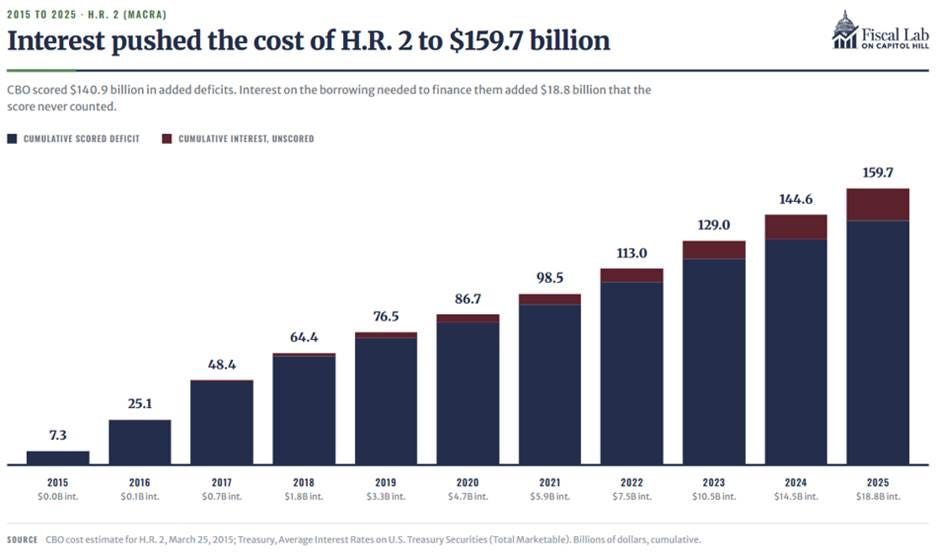
This still understates the problem, because MACRA was financed during a stretch of unusually low rates. Had CBO’s own January 2015 forecast held true, the cost would have been closer to $34 billion, or 24 percent above the headline score. Looking forward, CBO projects a $1.9 trillion deficit in fiscal year 2026, which, at an average rate of 3.5 percent, generates roughly $66.5 billion in interest in 2027 alone, a cost that recurs as the debt is rolled over.
CBO’s scoring convention is not wrong so much as incomplete due to statutory requirements put in place to provide a consistent basis for comparing proposals. The problem is that Washington presents the incomplete headline score as the full fiscal cost. A more complete score would show three figures: the direct budgetary effect, the debt-service cost that follows when that effect is deficit-financed, and a sensitivity range for rates above the baseline.